A Focus On St. Louis
What's holding St. Louis back?


Source: gettyimages.com
Seems like I’ve written a lot about Chicago and Detroit in the last few weeks. Time to offer some thoughts on another Rust Belt city, St. Louis.
I like St. Louis. In fact, despite the fact that it’s on the Mississippi River and not the Great Lakes, it’s the city that reminds most of Chicago and Detroit, both in good and not-so-good ways. Aesthetically, St. Louis looks similar to Chicago, but at Detroit’s size and scale. There’s a distinct housing style and neighborhood composition that reminds me of Chicago. I find it appealing If late 19th/early 20th century Detroit had devoted more energy to urban design, I’d imagine it would look like St. Louis. Here’s an example:
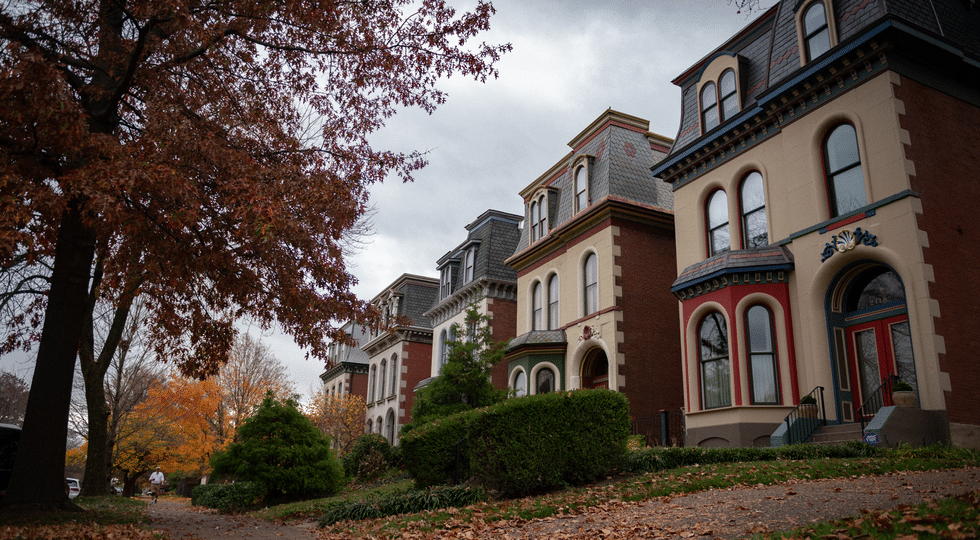
Source: greaterstlinc.com
On the other hand, the more disinvested parts of St. Louis are more reminiscent of comparable areas in Detroit – vacant lots, abandoned buildings, reminders of earlier glory. In that sense St. Louis looks like Chicago would have, had it experienced Detroit’s level of devastation.
Demographically, the three cities are different. At the metro level, Chicago is the most diverse of them, with considerable Latino, Black and Asian populations. Latino and Asian groups are rising steadily in numbers there, but the Black community’s numbers have been dropping for years. Detroit is less diverse than Chicago. Detroit has a smaller but rapidly rising Latino population, and significant Arab and South Asian enclaves.
St. Louis seems the least diverse to me. It’s the city that maintained its rigid white/Black makeup the longest, and it’s closest to the Detroit I remember growing up in during the ‘70s and ‘80s. I’ve always felt a deep racial undercurrent in St. Louis that seems to permeate everything about it.
I bring this up because there’s been an interesting discussion on X, formerly Twitter. The original poster compared Detroit and St. Louis’ revitalization efforts and said Detroit’s surpassed St. Louis. They wanted to know what Detroit did to accelerate its rebirth, and what’s causing St. Louis to lag.
A great question. However, the responses were mostly rudimentary biases related to economic differences in the cities, or outright negative social commentary. The kind that recalls perceptions people had of ‘70s and ‘80s Detroit.
I’d summarize the X comments on why Detroit has taken off while St. Louis still struggles in one of five categories:
1. Detroit’s corporate wealth stayed in the metro Detroit region, while St. Louis’ did not. Many commenters saw major corporations leaving the St. Louis metro area, while Detroit’s two most recognizable Fortune 500 companies, General Motors and Ford, remained. They said there was still wealth in suburban Detroit that doesn’t exist at the same level in suburban St. Louis.
2. Dan Gilbert. The Detroit billionaire who founded Quicken Loans/Rocket Mortgage made it his personal mission to buy properties in downtown Detroit and revitalize them. Gilbert relocated his Quicken Loans headquarters from suburban Livonia to downtown Detroit in 2010 and built a significant real estate portfolio there since. I’d also add Mike Illitch and the Illitch family, the founders of Little Caesars Pizza, as a major downtown Detroit investor, but they’re probably less well-known.
3. Competition with Kansas City. St. Louis isn’t the only large metro in Missouri, and there’s competition coming from the other side of the state. There’s a sense that Kansas City’s growth at St. Louis’ expense.
4. St. Louis’ political fragmentation. Metro St. Louis is a famously fragmented metro area. St. Louis City separated from St. Louis County in 1876 and has kept the exact same boundaries since. That’s directly led to two outcomes: 1) there are towns as small as 200 residents that are independent; 2) there are many suburban areas that would typically be a part of virtually any other major city; and 3) the city/suburb divide in the St. Louis metro area is about as wide as any metro in the nation.
5. Dealing with “race/crime/racism.” Race and crime are intertwined in St. Louis, much like I remember in Detroit many years ago. There are well-known “don’t go” sections of St. Louis (“don’t go north of Delmar”). Socially, I’ve found St. Louis to be one of the most rigidly segregated metros in the Rust Belt, perhaps in the U.S. I think a lot of that is because St. Louis hasn’t been as impacted by late 20th/early 21st century immigration as many other cities.
That’s a good starting point for understanding why St. Louis has lagged behind Detroit perception-wise, if not in reality. But it doesn’t describe why, also perception-wise, Detroit has surpassed St. Louis. I think it comes down to these five factors:
1. St. Louis’ challenges are magnified by the 1876 “Great Divorce” boundaries and subsequent suburban fragmentation. St. Louis’ negatives, like crime, are concentrated in the relatively small core city (around 280,000 people within its 66 square miles). I liken it to being a fish in a fish bowl, being watched – and chastised – by the 2.6 million suburbanites that surround them.
2. Detroit had a very public municipal bankruptcy that brought a lot of attention to it. Detroit’s 2013 bankruptcy filing remains the biggest such bankruptcy in the U.S. It was an admission of failure for the city, and an embarrassment not only for city residents, but for suburbanites and the state of Michigan. Detroit had hit a very clear bottom that St. Louis has yet to reach.
3. Suburban perceptions of Detroit have gradually shifted over the last 20-30 years. L. Brooks Patterson, the county executive of affluent suburban Oakland County north of Detroit between 1993 and 2019, based his entire tenure in office as an anti-Detroiter. I’ve commented on his 2014 New Yorker interview many times, but here’s this nugget again, from the article’s author Paige Williams:
“Patterson told me, “I used to say to my kids, ‘First of all, there’s no reason for you to go to Detroit. We’ve got restaurants out here.’ They don’t even have movie theatres in Detroit—not one.” He went on, “I can’t imagine finding something in Detroit that we don’t have in spades here. Except for live sports. We don’t have baseball, football. For that, fine—get in and get out. But park right next to the venue—spend the extra twenty or thirty bucks. And, before you go to Detroit, you get your gas out here. You do not, do not, under any circumstances, stop in Detroit at a gas station! That’s just a call for a carjacking.””
That was a prevalent sentiment through the 1990’s in Detroit. But I think it started to turn around in the early 2000s. Other cities across the country were beginning to gentrify as newcomers settled into older urban neighborhoods. Detroit was getting a second look from suburbanites who may have wanted similar options, and they found… almost none. The corruption of the Kwame Kilpatrick administration and the wildfire of foreclosures set off by the 2008 financial crisis halted progress, but it picked up steam again once Detroit was officially out of bankruptcy in late 2014.
4. Detroit benefitted from the deep involvement of a strong philanthropic community. The Ford, Knight, Kreske and Mott foundations, the philanthropic outgrowths of Ford Motor Company, Detroit Free Press newspaper, Kmart and General Motors, took serious interest in Detroit’s revitalization. Kresge Foundation was instrumental in the founding of the Detroit Riverfront Conservancy in 2003, and has contributed to the fantastic Detroit Riverwalk I wrote about last week. Ford Foundation had long departed from Detroit for New York City and a national focus, but the city’s trials brought them back. Each played a pivotal role in the ”Grand Bargain”, which allowed the City to hold onto its art assets at the Detroit Institute of Arts, and exit bankruptcy in just 17 months.
5. Detroit wound up with a social transformation that St. Louis has yet to achieve. A combination of all these points has led to different perceptions of the city. Two of Detroit’s four professional sports teams, the NBA Pistons and the NFL Lions, spent decades at stadiums in Oakland County. Both have rejoined the Tigers and Red Wings downtown and contribute to a new vibrancy there. Unfortunately, I don’t see a break in the stalemate between city and suburbs in the St. Louis region.
I’ve often remarked that Detroit’s collapse was a social one, not an economic one. The same is probably true of St. Louis and many other Rust Belt cities. During the tumultuous 1960’s and 1970’s, all Rust Belt cities were rocked with economic disruption that exposed deep faults in their social fabric. I’d say the economic restructuring has proven easier to repair than the social side. But Detroit’s made great advances in healing old wounds.
St. Louis can learn from that.
A1, A2, and B4 all seem like variations on a theme to me. For lack of a better way of saying it, from the outside it looks like metro Detroit somehow or other retained a leadership class separate from its political leaders, while it isn’t apparent that St. Louis did. I have gotten the impression that St. Louis lost more HQs, doesn’t have as much philanthropic money or clout, and doesn’t have as many (or any?) entrepreneurs who have been as successful as the mortgage guy.
I also suspect that Detroit benefits from more national press coverage as well. The big 3 automakers were so important to the US that stories about Detroit generate more interest than stories about other Rust Belt cities. I can’t prove this, but I believe that people behave differently when they think that people in the rest of the country might care about what they are doing. It’s conceivable that if you accomplish something in Detroit, you might get a write up in the NYT. I don’t think that is nearly as likely to happen with any other Rust Belt/river town except maybe Chicago.
The "Great Divorce" in St Louis definitely explains a lot. Honestly, if even just the first ring of inner suburbs were part of the city proper (Clayton, Richmond Heights, University City, etc), that would go a long way toward improving the city's outlook. Everyone knows that Clayton/U City are where the tax base is -- they're urbanized, vibrant places with large private businesses and a university community. They're indistinguishable from the city proper if you're just driving around, but nevertheless get to be their own independent munis that support the county but contribute nothing to the city. In any other jurisdiction, Clayton would be a real part of the city that it sits next to. In St Louis -- legally, psychologically, and emotionally -- it's a completely different world.