A Jesse Jackson Memoriam
Jackson, and Barack Obama, showed Democrats how to win nationally. But establishment and progressive in-fighting took Democrats' eyes off the prize, and we face a reckoning as a result.

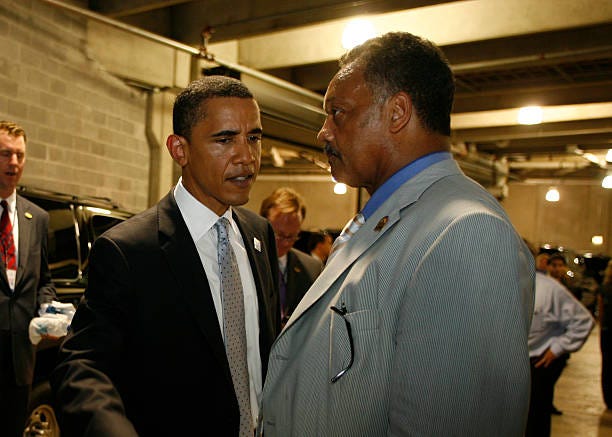
Senator Barack Obama (D-IL) and Civil rights activist, Baptist minister and former Democratic presidential candidate Jesse Jackson prior to the AFL-CIO's Democratic Forum at Soldier Field in Chicago, IL on August 7, 2007. Source: gettyimages.com
Rev. Jesse Jackson played a pivotal role in the transition of the Civil Rights movement into mainstream political philosophy. Jackson, almost by himself, advanced the movement’s goals from eliminating the South’s Jim Crow authoritarianism, to a focus on poverty and segregation in America’s cities. He picked up the mantle of the Martin Luther King-led movement, and made it bigger, wider and more inclusive. Yes, more inclusive.
Sadly, I think much of his work was dismissed by national media at the height of his influence and popularity, because few would look beyond his charismatic demands on the economic and political establishment. To them, he was loud, brash and divisive. I’ll admit, he was often that for me, too.
But in the wake of his passing, I think it’s also apparent that three other facts are also true. There would not have been a President Barack Obama without Jesse Jackson. The message that Jackson crafted, and Obama molded, was created in the highly segregated city of Chicago and was developed to address deeper economic and social concerns. Their message was a product of and response to the Northern urban segregation that was dominant at the time.
Unfortunately, their message was co-opted by establishment and progressive Democrats in their battles for control of the party. Because both factions saw the Rainbow Coalition, the faction that emerged out of their message, as a junior partner in the party that must be led, not followed. That reduced the movement to smaller parts of a larger whole, rather than an organizing, unified vision for the party and nation.
Jesse Jackson’s Duality
Adam Serwer’s exceptional article in the Atlantic noted the vast differences of opinion of the Jackson persona in his depiction of growing up in D.C. in the ‘90s:
“When I was growing up in Washington, D.C., in the 1990s, many businesses proudly kept in their windows signs from Jesse Jackson’s 1984 and ’88 presidential runs. He was a revered figure, someone people in D.C. were deeply thankful for.
Yet when you turned on the television, you saw another Jesse Jackson. This Jesse Jackson was a dangerous man, a radical, a demagogue, someone who thrived off fomenting racial division. To the people around me, Jackson—the reverend and Civil-Rights leader—was a hero. But to the people I saw discussing the news on television, he was both an incendiary agitator and a ridiculous, almost comic, figure.”
But immediately following the above, Serwer says this:
“The subtext of all this commentary was that Black Americans would make more progress if their leaders were not so flawed. Barack Obama put the lie to this argument; squeaky-clean by personal-conduct standards, all he did was drive the same people who hated Jackson more insane.”
From Civil Rights to Black Power
I won’t lie. As a young adult in the ‘80s I had mixed feelings about Jesse Jackson. I appreciated the message, but not necessarily the approach. As someone with a college degree and a desire to make an impact in the world, I supported Jackson’s efforts to open doors in elite spaces that had traditionally been closed to Blacks. But I was often concerned that his abrasiveness diluted the message.
There was also a reflection of this within the broader Black community, particularly in the Black religious community. I’m the son of an African Methodist Episcopal Church pastor, a church denomination that would be considered mainline, establishment or “old-school” by contemporary Black Church standards, and I identified with the early leaders of the Civil Right movement.
The Civil Rights movement was initially led by personally-conservative-but-politically-moderate Black pastors like Dr. King. Their goal was to appeal to whites’ sense of fairness, to become a nation that adheres to the principles it upholds. That approach was successful in getting Congress to enact the Civil Rights Act of 1964, which outlawed segregation in public places, banned employment discrimination on the basis of race, color, religion, sex, or national origin, and desegregated schools.
But it was clear that it was not enough to reduce deep economic and social inequality in America.
It wouldn’t take long for the Black Power movement to rise to challenge the Civil Rights movement leadership. The rise of Malcolm X, and his assassination, brought attention to the urgency Northern urban Blacks were experiencing. More and more Black urban citizens across the country were realizing that no longer being excluded was not the same as being included. The 1964 Act did not put an end to discriminatory activity. It made it unlawful. And little was done to enforce it.
Dr. King and Rev. Jackson had two very different perspectives in the Black experience and that showed up in the civil rights/Black power clash. Dr. King was born in the South and stayed there. As the son of a successful and influential Black pastor in his own right, Dr. King grew up in a middle-class household. From his perspective, the primary challenge to Black America was the South’s institution of Jim Crow. Remove the barrier, watch integration take hold.
Rev. Jackson was 12 years younger than Dr. King. He was born to an 18-year-old high school student impregnated by a 33-year-old neighbor and grew up in dire poverty in South Carolina. He became an excellent student and three-sport letter athlete in high school. After starting at the University of Illinois on a football scholarship, Jackson transferred to North Carolina A&T, an historically Black university. Jackson graduated from NC A&T in 1964 and was accepted at the Chicago Theological Seminary to pursue a master’s in divinity. He left the seminary in 1966 to join the Civil Rights movement.
It was Jackson’s Chicago experience where King’s and Jackson’s perspectives further diverged. King’s approach was rooted in his knowledge of Jim Crow. It remained there. But Jackson’s Chicago experience was a revelation to him. Blacks could, and did, vote there. Blacks could sit anywhere on a bus. But Blacks were limited in where they could live, the jobs they could hold, the quality of education they could expect, and the certainty of protection by local police. Jackson saw a different kind of racism at work in Chicago – one that I’ve termed Northern exclusion.
The years between 1964 and 1968, when Dr. King was assassinated, was the peak of the civil rights/Black power clash. The Student Nonviolent Coordinating Committee (SNCC) under Stokely Carmichael became formidable challengers to the civil rights establishment. The Black Panthers Party signified a move toward Black nationalism, and they were willing to use a militant approach to support it. Nationwide riots, Olympic athletes raising black-gloved fists, independent movements to create new Black “nations” within the U.S. all spurred Congress to hastily approve the Civil Rights Act of 1968, just one week after Dr. King’s assassination. Just four months later Congress would enact the Housing and Urban Development Act, which expanded the role of the new U.S. Department of Housing and Urban Development, established in 1965.
Jackson after King
That was the volatile environment that Jesse Jackson entered following Dr. King’s assassination. In retrospect, I believe he has not been given enough credit for diffusing the tension of the times, refocusing and synthesizing the work of the civil rights and Black power movements, and charting a new vision for the nation.
I won’t belabor you with the work-a-day details of Rev. Jackson’s work with Operation Breadbasket and Operation PUSH. But I will focus on the coalition he sought to create: the Rainbow Coalition that served as his platform for his bids for president in 1984 and 1988.
I pull from Adam Serwer’s article once again:
“(During Jesse Jackson’s run for president in) 1984, Jackson described America as a “quilt” with “many patches, many pieces, many colors, many sizes, all woven and held together by a common thread.” In 1988, he extended the metaphor—arguing that progress could not be made without the aid of people from very different backgrounds, with very different identities.
“Farmers, you seek fair prices and you are right—but you cannot stand alone. Your patch is not big enough. Workers, you fight for fair wages, you are right—but your patch of labor is not big enough. Women, you seek comparable worth and pay equity, you are right—but your patch is not big enough,” Jackson said. “Students, you seek scholarships, you are right—but your patch is not big enough. Blacks and Hispanics, when we fight for civil rights, we are right—but our patch is not big enough.”
Another excellent piece on Jackson, by Matt Yglesias at Slow Boring, notes that Jackson’s prescience in the 1980’s is the basis for today’s Democratic Party. He cites and quotes the very same speech that Adam Serwer did, but included one additional line Serwer left out at the end:
“Gays and lesbians, when you fight against discrimination and a cure for AIDS, you are right — but your patch is not big enough.”
Yglesias then goes on to say that the rest of the 1980’s saw the Democratic Party become a party of, well…
“…the party of groups — African Americans, gays and lesbians, Jews — that saw themselves as marginalized in one way or another. But the party as such was constructed as a kind of loose, largely non-ideological set of coalitions.
It was also losing a lot.”
He’s right. Yglesias then describes an ongoing battle between establishment and progressive Democrats for control of the party:
“Jackson, in his 1984 convention speech, argued that “we cannot be satisfied by just restoring the old coalition” and that Democrats needed to become an ideological party that would “dream of a new value system.” In his 1988 campaign, Jackson assembled a version of that, transcending his status as a Black candidate to become an ideological candidate of the progressive left.
But, unlike (1964 Republican presidential nominee Barry) Goldwater, he didn’t win the nomination. Bernie Sanders, at the time the mayor of Burlington, was one of the few officeholders to endorse Jackson’s campaign. Had Sanders beaten Hillary Clinton and Donald Trump in 2016, that would have been a kind of Reagan moment. But that didn’t happen either. The establishment forces have been firmly in control of the Democratic Party from the time of Jackson’s failed bids through to Sanders’s.
Here, however, I disagree with Yglesias. The “Reagan moment” he refers to is the Democrats’ transition into the ideological party that would dream of a new value system, as Jackson noted. That moment did happen with the election of Barack Obama in 2008 and 2012. But continued battles between establishment and progressive Democrats to seek dominance over the party have prevented Democrats from forging the winning coalition they have.
Obama was the rightful heir of Jackson’s Rainbow Coalition, and he governed in that manner. I think it’s no coincidence that Jackson and Obama come from Chicago, after being born in other places, and found a way to craft a positive, pragmatic and inclusive vision based on what they learned in perhaps the nation’s most segregated city.
In fact, there was one politician from Chicago who united both Jesse Jackson and Barack Obama: Chicago Mayor Harold Washington.
How Chicago Figures In
As noted in this NBC 5 Chicago article on the 25th anniversary of Washington’s death, there would be no President Barack Obama without Harold Washington (and the political organizing and coalition building chops that Jesse Jackson brought to the Washington campaign):
“In the mid-1980s, Obama was just out of Columbia University and was looking to build both a career and an identity as a black man. He wanted to live and work in a city where blacks were in charge of their own political destiny. At that time, Harold Washington was the most prominent black elected official in America. Obama wrote a letter to City Hall, asking for a job. He got no response. But when he saw an ad for a community organizer in Chicago, he jumped at it. Years later, accepting the Harold Washington Award from the Congressional Black Caucus, Obama said, “I originally moved to Chicago in part because of the inspiration of Mayor Washington’s campaign.””
Jackson was instrumental in Washington’s election to mayor in 1983, and again in 1987. Washington employed much of what he learned from Jackson’s Rainbow Coalition building to his own mayoral campaign. Washington knew he would not be able to become mayor of Chicago simply by dominating the Black vote. He needed a cross-section of voters from other demographic groups in Chicago. That meant reaching out to the so-called “lakefront liberals” that lived on the city’s North Side, which included the Northalsted (formerly Boystown) neighborhood that is the Midwest’s largest LGBTQ community. It meant partnership with Chicago’s rising Latino and Asian populations of the time. And it also meant connection with the blue-collar, union-oriented white ethnic neighborhood residents that inhabited Northwest and Southwest Side neighborhoods. Washington won the 1983 Democratic mayoral primary with a narrow plurality in a three-way race that included the incumbent Mayor Jane Byrne and Cook County State’s Attorney Richard M. Daley, son of long-time Chicago Mayor Richard J. Daley. Washington won the general election against Republican Bernard Epton, 51.7% to 48.0%.
Washington did not win a majority of votes in other demographic groups but won enough to pair with his overwhelming Black majority vote and get elected as mayor. Washington did face the three-year-long “Council Wars” orchestrated by the all-white majority on the City Council (29 out of 50 alderpersons), which blocked virtually all political appointments to City departments and agencies. Yet he was still able to broaden his coalition. In 1987 Washington was able to defeat former mayor Jane Byrne again in the Democratic primary, and then defeat one of Council War’s leaders, Ed Vrdolyak, in the general election by a 53.8% to 42.8% margin.
This demonstrated the potency of a new coalition that Jackson would use as a proof of concept in 1984 and 1988 and would propel Obama into the presidency in 2008 and 2012.
Jackson drew the ire of conservatives because of his bombast, but he ultimately was right. Obama drew the ire of conservatives too, as they tried to paint him as exotic and extremist. He was also right. Both understood that the Rainbow Coalition was the winning coalition. But the establishment and progressive factions fought to control the Rainbow Coalition, not build from it.
President Obama wasn’t just a stand-in for the Rainbow Coalition; he was the personification, the epitome of it. And once Obama’s second term started and the battle between the establishment and progressive factions was renewed, a wide opening was made for a frightened Republican Party intent on not letting that winning coalition take over again. Even if it meant getting behind someone as objectionable as Donald Trump.
The Democrats’ winning faction is no longer called the Rainbow Coalition, but it still exists. But because establishment and progressive Dems each wanted to control the coalition to control the party, our nation sits where it is today, on the cusp of losing its democracy. Democrats will win again once all factions unite behind the next iteration of the coalition Jesse Jackson formed.
Interesting take on the Rainbow Coalition, but very flawed [IMO] in much of its analysis. Coalitions work when they are based upon shared interests; the Rainbow Coalition was always and remains too heterogenous to be successful in any but the short term or locally. The Obama victory, remember, had as much to due to dissatisfaction with the recent banking crisis and endless wars as with the Obama program [he was losing in most polls prior to that crash] and he drew two weak and divisive opponents.
He won in a wave election in 2008 but massively overreached on Health Care etc. sparking the Tea Party revolt which caused the loss of a huge House majority and nearly the Senate as well in 2010. The bleeding continued for the next six years and [despite a win in 2012] over 1000 elected positions were lost - wiping out a whole generation of new Democrat elected officials. The result: a balkanized party and a gerontocracy leading teenyboppers when the House flipped in 2018.
Hispanics have little interest in reparations for slavery, Union Workers less in national healthcare, Asians bitterly oppose affirmative action, many [most?] American Jews have little sympathy for Palestinians. Orthodox Jews have voted GOP for two decades now, working-class whites and increasing numbers of working-class Hispanics and Blacks voted for Trump.
We are in the midst of a political transition, like 1929-1933 or 1960-1980. It's still undecided, but Rainbow Coalitions will never last and the 2030 census may settle matters for a decade or more.