Background For Yesterday's Dallas Post
A team of urbanist researchers foresaw the Metroplex's current challenges.

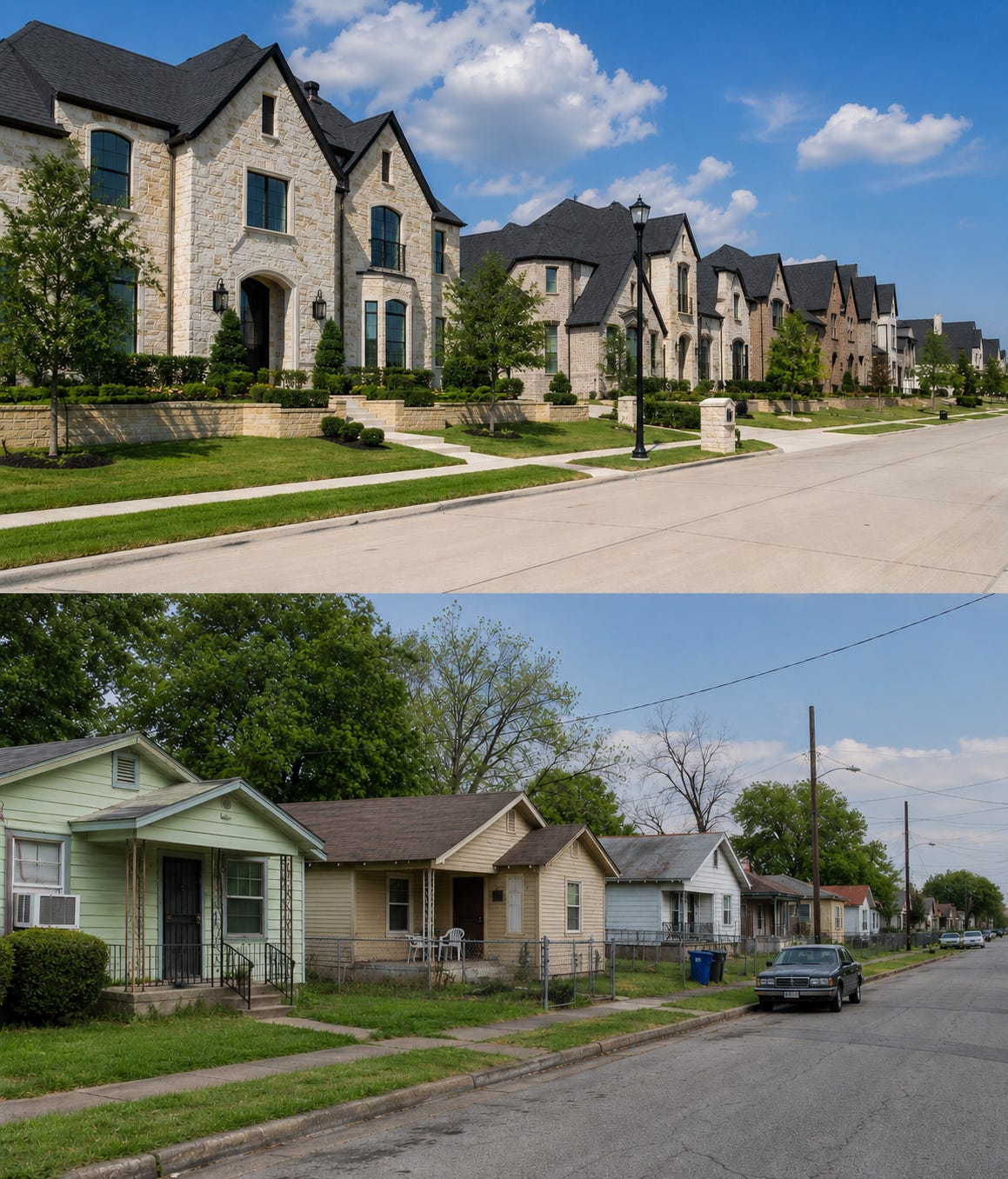
On the top: new luxury homes in Frisco, TX. On the bottom: older modest homes in South Dallas. Source: chatgpt.com
In yesterday’s post on Dallas, I referred to a study I contributed some eight years ago that examined development patterns in the Chicago, Dallas and Los Angeles metro areas. I thought it might be a good idea to reflect a little on that project, and see how things have transpired in the three metros since then.
In early 2019, I was a speaker at a symposium called Policies to Promote Inclusive Urban Growth. It was held in Dallas at the George W. Bush Presidential Center on the campus of Southern Methodist University, and the event also served as the public release of a report which I worked on, Beyond Gentrification: Towards More Equitable Urban Growth, published by the Center for Opportunity Urbanism (If you get a chance I encourage you to check out the video of the event, found at the first link above).
I’ll acknowledge the obvious right up front. Many urbanists who follow me may recognize some of the names involved in the project as right-leaning urbanists who have often taken a pro-suburban, pro-market approach to metropolitan development. That does not include me, or many others who worked on the project. We were brought in to do serious, honest and credible analysis of the metro areas we covered.
Perhaps our biggest difference was over the endurance of urban revitalization (i.e., gentrification) in major cities. The right-leaning folks said they saw it as a temporary condition, fueled by policy interventions like tax increment financing districts, subsidies and urban renewal projects, and the source of displacement and disruption in low-income communities. They also believed that the suburban development pattern was what most Americans wanted and while urban revitalization/gentrification was needed, it would never replace the suburban model. I, and others, argued that urban neighborhoods suffered from a lack of investment and that such places needed revitalization to strengthen them as communities.
Anyway, our analysis of Chicago, Dallas and Los Angeles had key findings that became clear through our research:
· Chicago was shown to be a “bifurcating” city. Chicago had rising numbers of affluent residents moving to lakefront neighborhoods throughout the city and falling numbers of lower-income residents in the city’s inland areas. This put pressure on middle-class households, particularly on Black middle-class residents.
· Dallas was also shown to be bifurcating, but at the metro level. The Metroplex grew rapidly well into the 21st century, but almost exclusively in the suburban portions of the metro area. Dallas’ long history of racial and economic segregation factored into this, but had the “economic vibrancy and the city’s comparatively abundant and inexpensive land” to build its way into more economic mobility and inclusiveness.
· Los Angeles’ massive increases in housing prices and rents was at the heart of displacement concerns among middle- and low-income LA residents. The researchers acknowledged a severe housing supply issue, mostly affecting renters in the region, and that “no magic formula has emerged that solves the supply problem in a meaningful way— yet.”
Anyway, I invite everyone to take a look at the report and tell me whether you agree or disagree with its findings. Also, if you witnessed any changes in the cities over the last eight years that have pushed the cities on a different course than we projected, let me know.
https://www.newgeography.com/files/Gentrification%201-19%20Toward-More-Equitable-Urban-Growth.pdf
Your analysis of Chicago tracks closely to Baltimore, not the Midwest but also a Rust Belt city held back by the divide of segregation.
The Dallas chapter reflects the on-the—ground reality of DFW that is missed or ignored by the rosy infatuation of California with the red state land use policies of Texas. While housing production booms on cheap open land to the north, making home prices appear cheap to California or New York transplants, the piece correctly points out that is at odds with the experience of low and even middle class Dallasites in a market that is less and less affordable.
However, the solution proposed in the piece are merely to accept Dallas extreme and rigid lines of segregation—avoid disrupting them, work within them and just do better. This is not inclusive growth. It is precisely the paradigm that has not worked for either neighborhood or individual economic growth over the decades in Dallas or other segregated cities. Until we are willing to disrupt and change the segregation holding these cities back, we can expect the same harms of uneven, inequitable and unstable growth to continue.
Both your and Cullum's pieces refer to "inclusive growth", but seem to have an un-stated vision of what "inclusive" would mean? Is there a specific (or general!) class or racial inclusivity goal that is our target?