Chicago's Waning Influence
A case can be made that Chicago hit its peak economic and cultural influence in the 1990s and early 2000s. Why has it waned since?

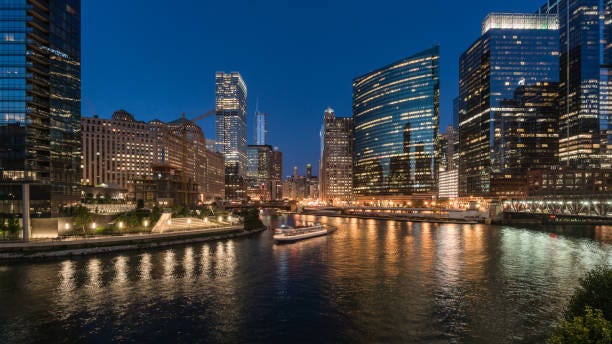
The Chicago River and RiverWalk at night, Downtown Chicago. Source: gettyimages.com
Here we go again.
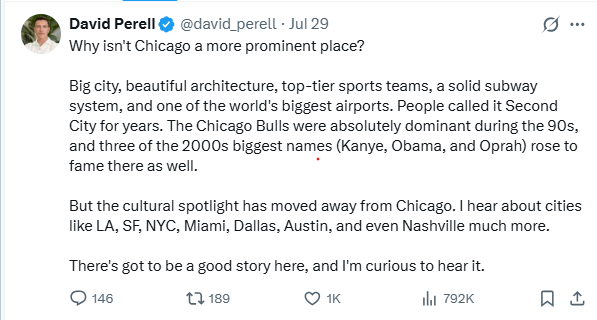
Chicago figured prominently in my X feed Wednesday. X user David Perrell posed a legitimate urbanist-type question: why doesn’t exact the same kind of influence nationally today that it did 20-30 years ago? Here’s his original post:
Meanwhile, I noticed definite themes in the comments. Left-leaning commenters offered thoughtful, nuanced explanations for Chicago’s receding national influence. Commenters often said things like:
· “tech’s 21st century growth centered on the coasts left Chicago behind;” or
· “the city’s diverse economy works against it and makes Chicago a jack-of-all-trades/master-of-none city;” or
· “Chicago’s overall violent crime is bad, but perception vastly exceeds reality. Much of Chicago is as safe as any large city nationwide. Avoid the crime hotspots, you avoid the crime;” or
· “Many Chicagoans think we’ve already achieved world-class status and given up the push to attain it. But the global economy and society have changed, and Chicago hasn’t kept pace.”
The comment below from Alexander Lacherbauer was perhaps the most thoughtful, nuanced and complete response in this regard:
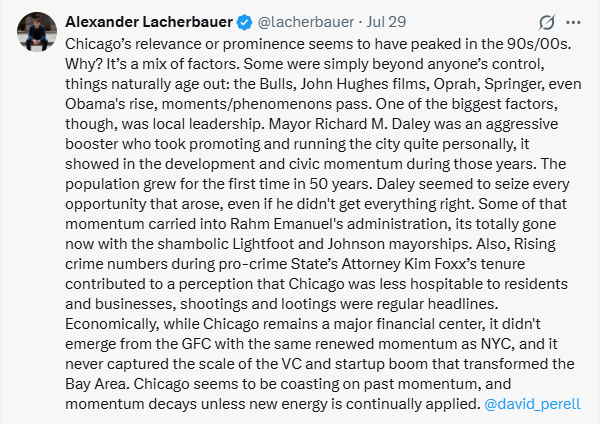
I think Lacherbauer is on target with much of this. There was a lot of attention given to Chicago via John Hughes films, Oprah and Jerry Springer (and other daytime talk shows based here), winning basketball teams and the most popular player in the world in Michael Jordan, as well as being the hometown of an eventual U.S. President. Chicago was in the news a lot. But all of what made Chicago popular then was ephemeral – Michael Jordan couldn’t play forever; Mayor Daley couldn’t run the city forever.
A slice of the media industry came here through talk shows, but is that scalable to building a media empire that completes with New York City and Los Angeles?
I’ll also add that while Chicago’s stature and influence was rising then, at the same time there were troubling news stories and media depictions of another Chicago (Candyman, 1992; Losing Isaiah, 1995) that was violent, dangerous, and nearly as influential in shaping perceptions of the city. For every Ferris Bueller’s Day Off (1986), there was a There Are No Children Here (1992).
There was plenty of material out there to focus on Chicago’s negatives. Right-leaning commenters focused on well-worn complaints that could apply to Chicago, or any other city one chooses not to like:
• Crappy weather;
• Overly influential unions;
• Local and state political corruption;
• Incompetent leadership;
• High levels of violent crime;
• High property taxes;
• Overrun by Black people;
• Too many immigrants.
At best they presented actions (elect new leaders; put corrupt politicians in jail; lock up criminals; deport immigrants; among others), not policies, to change the city’s fortunes. Better yet, I think most people holding these views just see Chicago and similar cities to be places to avoid, until they make tangible, visible changes that can entice them back.
Don’t dismiss the culture
Friend and fellow Substacker Aaron Renn chimed in with this comment:
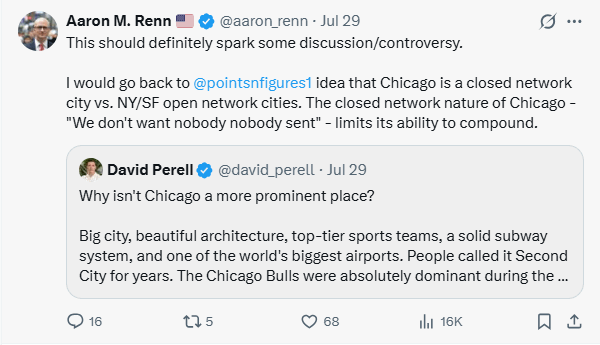
For more on Aaron’s position I’d encourage you to read his article here. The quote that nails it:
“One of the most important characteristics of closed network environments like Chicago is that you need a patron to gain entry to and move up in the network. The title of one of the greatest books about Chicago politics sums up the local attitude perfectly. It’s called We Don’t Want Nobody Nobody Sent. The phrase comes from Abner Mikva’s first attempt to get into Chicago politics:
‘One day in 1948, energized by the candidacy of Paul Douglas, Mr. Mikva presented himself at the 8th Ward Regular Democratic Organization headquarters. “I came in and said I wanted to help,” Mr. Mikva told historian Milton Rakove. “Dead silence. ‘Who sent you?’ the committeeman said. I said, ‘Nobody.’ He said, ‘We don’t want nobody nobody sent,’” a phrase Rakove took for the title of his oral history of Chicago politics.’
By contrast, Silicon Valley is an open network. Clearly, relationships, patron-client relationships, etc. matter a lot there. But the network is permeable. As Carter says, the question is much more “Can you do it?” than “Who do you know?” NYC is similar. It’s a very competitive market, but an open one.”
Chicago is very much a “it’s not what you know, but who you know” kind of city. Unfortunately, this serves as a limit on what Chicago can accomplish – economically, politically, even socially. Whenever Chicago surpasses that hurdle, it will unlock amazing potential.
Renn is a neo-liberal hack pretending to care about Chicago's success. A new Chicago is being built along the lake. The challenge is supporting it. Renn will chronicle every problem with Chicago but he will not identify the birth of its new economy.
Ehhh....a single 80-year-old anecdote from a 50-year-old memoir is hardly compelling evidence about today. Particularly in a place where the leadership demographics are as enormously different as Chicago 2020s compared to 1940s.
Based on a steady amount of time in the Bay Area over the past 30 years, it seems culturally much more of a closed-network place today than Chicago or NYC. Couldn't say regarding the tech sector in particular though.
NYC seems to have shifted in that regard, become less closed-network than it used to be. Chicago seems today more or less indistinguishable from NYC on this particular dimension.