Cities Within Cities, Part 1
When "out of sight and out of mind, until the new overwhelms the old" becomes the predominant urban development pattern.

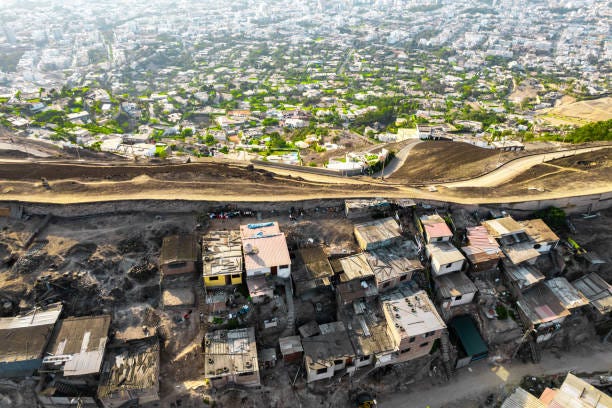
This is a picture of Lima, Peru, but there are divides in American cities that are nearly as stark as this one. Source: gettyimages.com
If there’s one city-related thing I enjoy doing, it’s breaking down cities into smaller pieces to gain a better understanding of how they’re made up. I don’t think too many people do this, nor really understand the value in it.
As for me, I do it because I’m fascinated by how, depending on one’s social and economic position, people can have vastly different opinions on the very same city. You live in one place, and the city can be full of economic opportunity; live in another place and the city has been in a depressive state for decades.
The thing is, both can be true. You just have to find the data that supports the view.
That’s not easy to do. There are cities that do a good job of highlighting their strong points and masking their deficiencies. The most common way is through marketing and branding.
Other cities, however, try to do the same through policy. When they can, some cities will gobble up adjacent land through annexation or city/county consolidation, and the new development that explodes there becomes the economic face of the city. Sadly, this means some cities can turn their backs on their less fortunate sections of the city and bask in the accolades praising the spanking-new development in the city’s new outskirts.
The problem is, not every city has that policy option. Virtually every core city that reached its population peak prior to, say, 1980, is hemmed in by several incorporated suburban communities at their borders that prevent expansion. Some older cities have had the same boundaries for more than a century. Prior to 1854, the city of Philadelphia was contained only in the area that most people refer to today as Center City – downtown Philadelphia. But in 1854 the Pennsylvania General Assembly created the consolidated City and County of Philadelphia. The city’s had the same boundaries for the next 172 years, and counting.
Baltimore and St. Louis have had their current boundaries for nearly as long as Philadelphia but went a different route. Both once were the county seats of counties that shared their names, Baltimore and St. Louis counties, respectively. Baltimore pursued independent city status separate from Baltimore County as part of the adoption on the new state constitution in 1851. In fact, Baltimore has had independent status even longer than Philadelphia (175 years). St. Louis fought for independent city status in a more bitter battle known as the “Great Divorce”, when a rapidly growing St. Louis city that wanted to exercise its growing power demanded one of three things in 1876: 1) greater say in county government; 2) a city/county consolidation; or 3) separate from the county as an independent city. Option 3 won out and St. Louis has had the same boundaries for 150 years.
Baltimore and St. Louis, and to a lesser extent Philadelphia, regretted their independent or consolidated statuses during the rapid urbanization period in the late 19th and early 20th centuries. St. Louis, the smallest of the three cities (61 square miles), almost immediately closed in on its boundaries. St. Louis’ business elite and elected officials recognized the boundary effectively capped the city’s growth for good. There have been a few attempts to reunite St. Louis City and County through either consolidation or annexation, but they haven’t gone far. Baltimore (91 square miles) took a little longer to recognize its cap was becoming too small, but by that time Baltimore County was doing quite well, thank you. I don’t believe there have been any reunification attempts in Baltimore.
Philadelphia, meanwhile, was better able to weather the constraints of set boundaries. It was the largest of the three cities (135 square miles), and the only one to reach the one million population threshold. Even still, Philadelphia could not keep up with the growth of other fast-growing cities in the first third of the 20th century, like Chicago, Detroit and Los Angeles, which all accomplished their growth through booming economies and aggressive annexation policy.
Since the 1950s, other cities have pushed their way into major city status by aggressive annexations or consolidations. Houston, Oklahoma City, Phoenix and San Antonio are the largest cities in land area that are not consolidated with their respective counties. They all range between 500 and 640 square miles in size, accomplished entirely through annexation. Jacksonville, Nashville, Indianapolis and Louisville each went the county consolidation route and are all between 325 and 750 square miles in size.
Consider this table below. Look at how the eight cities mentioned above fared in the “growth game” since 1950:

In 1950, each of the cities were among the 100 most populous cities in the U.S., but probably only Houston (perhaps) would have been recognized as a major city at the time. Most would have been considered sizable regional cities, based partly on the state capital status of four of them (Indianapolis, Oklahoma City, Nashville and Phoenix). Only three of the eight cities were in the top 25 by population; Phoenix, the smallest of the group, had fewer people in 1950 than Fort Wayne, IN (133,607, ranked 72nd), Erie, PA (130,803, ranked 75th) and Wilmington, DE (110,356, ranked 95th).
Look at each city 70 years on. All had incredible population growth. But as impressive as their population growth was, what stands out even more is their land area growth, which exceeds their population growth, percentage-wise. Houston had the smallest percentage gain in land area of the eight cities, and it quadrupled in size (160 square miles in 1950; 640 square miles in 2020). Phoenix’s expansion is absolutely phenomenal — 17 square miles in 1950 to 518 square miles in 2020. It’s 30 times larger than it was in 1950.
Cities that have been able to add that much more land area have been able to craft an entirely different narrative about them, or even craft a new one where none previously existed. It allowed some cities to say that they were not burdened with the poverty, crime and dysfunction, when the truth was more like it was contained in areas out of view to new residents.
Expanded and consolidated cities led to a new development pattern for the cities that chose that path. Out of sight and out of mind, until the new overwhelms the old. Older, constrained cities, like Baltimore, Philadelphia and St. Louis, became much more reliant on redevelopment and revitalization, a more difficult and riskier endeavor.
For years, I’ve argued that cities that have been able to expand their physical size gain the following benefits:
· They are able to shift concerns about declining conditions in cities away from the spotlight;
· They are able to put development in newer areas into a stronger narrative about their success; and
· They are able to prosper from an ever-growing tax base that extends infrastructure and public services to the newer areas, often at the expense of the older ones.
Tomorrow, I’m going to write about three cities that have taken some form of the expansion efforts mentioned (and another) to improve their economic and social fortunes. And, with some data points I’ve gathered, I’ll show you how some “cities within cities” don’t always reap the benefits of that growth.
Good piece.
Love this. Reminds me of the work that a colleague and I did to standardize the size of the American city to illustrate the illusory nature and perception of population as a metric of civic success and health: https://beltmag.com/population-aint-nothing-number-standardizing-size-great-american-city/