Climate Change Is Causing A Decades-Long Cost-Benefit Analysis
Paraphrasing Ernest Hemingway: "How will the U.S. adapt to climate change? 'Two ways: gradually, then suddenly.'"

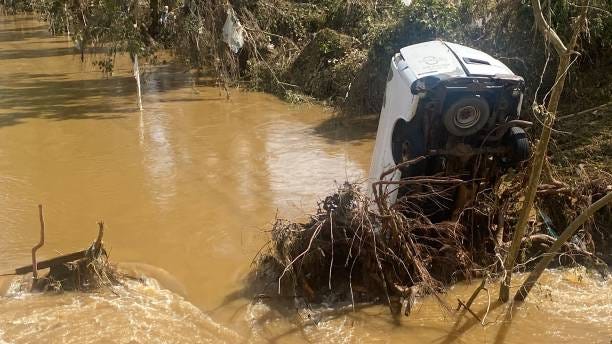
A submerged vehicle in the Swannanoa River in Asheville, NC following Hurricane Helene. Source: gettyimages.com
(Note: I started to write a piece about Hurricane Helene’s incredible impact on the Southeast, with an emphasis on how places like Asheville, NC were being considered as “climate havens” for Gulf and Atlantic coast folks. Then I realized I’d already written something very similar. Much of this is a replay of a piece I wrote back in June. I added some content about Helene in this update. -Pete)
Hurricane Helene’s path of devastating destruction, extending more than 400 miles from its landfall in Florida into Appalachian western North Carolina and eastern Tennessee, clearly tells us that no place is safe from the impacts of climate change. But people are looking at it wrong.
Helene looks like it will go down as one of the most deadly and costly hurricanes to hit the U.S.
I’m no scientist, but let’s understand the lessons of Helene first. The Washington Post captured it well. Helene was fueled by near-record water temperatures in the Gulf of Mexico. That caused it to develop and strengthen in very rapid fashion – it became a tropical storm on September 24, a Category 1 hurricane on September 25, and a Category 4 hurricane on September 26. Helene was also a fast-moving storm when it hit Florida’s Big Bend region, meaning it didn’t dump all its moisture close to the coast. Helene continued moving quickly as it went inland.
But as I understand it, Helene was devastating to southern Appalachia for a couple reasons. The first was the strong storms that hit the area two days before Helene arrived. From the Post:
“Those earlier rains “guaranteed that a lot of the water that came with Helene was not going to have anything to soak into, and so it was all going to be running down the surface to the nearest low-lying area and then just collect,” said Douglas Miller, a professor of atmospheric sciences at the University of North Carolina at Asheville.
They also created a wet, swampy environment that allowed Helene to cling to the last of its strength as it moved deep inland. Hurricanes weaken when they move over dry land — but the water vapor rising off the soaked ground in Helene’s path extended the storm’s life. “It’s slowing its demise,” Perry said. “It’s not strengthening, but it’s weakening slower than it otherwise would be.””
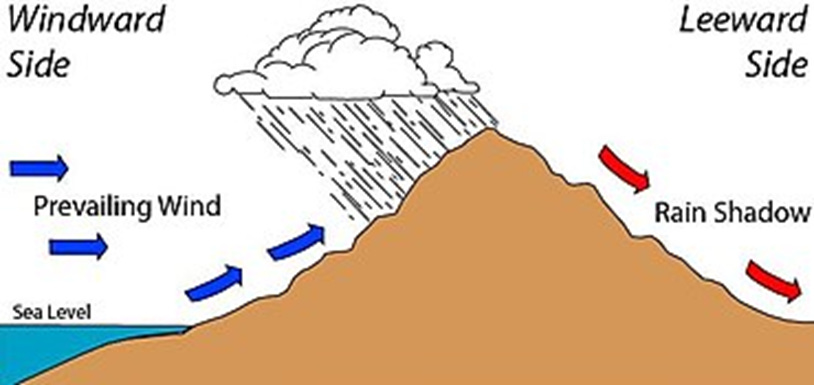
Before Helene even arrived, the area was already soaked with water. But I would think storm uplift played a role as well. As moist air is pushed upward by higher elevation, the moisture is squeezed out as the elevation rises:
Source: wikipedia.org
Observers are now trying to undermine the argument that there are “climate havens,” or places that are insulated from the effects of climate change. It’s an argument that’s been used to support climate-influenced migration to the Midwest, particularly the Great Lakes area.
I think that’s a misreading. All places will be impacted by climate change. The issue is one of degree. And in that sense, the Great Lakes may still win out in the long run.
More than a few of my Midwestern compatriots have pinned their hopes on climate change to lead the way in revitalizing our cities. The threat of natural disasters like hurricanes and wildfires, and the subtle and gradual impact of sea rise and drought, we tell ourselves, will mean people will give a new look to the Midwest. Yes, the Midwest can be cold, cloudy and snowy in the winter, and hot and humid in the summer. We have tornadoes. But most of the region has a fantastic supply of fresh water. And the threats we face in the Midwest aren’t existential in the way they are in the Gulf Coast and Desert Southwest of the U.S.
But the truth is, I've gone back and forth on whether climate change would benefit the Midwest. At first, I agreed with the climate change migration narrative, believing disaster recovery and the loss of fresh water would be too much for Sun Belt cities to overcome. Later, when the drought out west reached a peak a few years ago and people there started talking about pumping Mississippi River water (!) or even Great Lakes water (!!) westward, I became resigned to the fact that a political solution might one day be in the offing.
Today I’m back at my original position. The Midwest will benefit from climate change, but in a much more gradual fashion.
First, I think a lot of Midwesterners need to rid ourselves of a particular climate change fantasy. I used to think that climate change would produce climate refugees -- people displaced by Category 5 hurricanes, or Chicago/San Francisco-type fires. There will be elements of this; Hurricane Katrina displaced tens of thousands of New Orleans residents back in 2005, and Houston was an immediate and direct beneficiary, at least in relocation terms. A devastating fire could have the same impact as the Lahaina fire in Hawaii last year. But people will find a way to return and rebuild, eventually. Rebuilding is a testament to human resilience, and people will want to claim it.
Improved technology and public education will help places rebuild as well. Architects and engineers will design and build structures that can withstand high winds and pounding rains. They’ll probably also let coastal areas return to their natural state, and focus building further inland. Places prone to wildfires may try to widen the “wildland-urban interface” areas so that wildfires don’t immediately touch human-inhabited spaces.
We’ll find that shade will become more used as a tool against heat and humidity, and that air conditioning will cool covered public spaces to offer comfort (I’ll never forget visiting Las Vegas and seeing alfresco dining accompanied by air conditioning). Water conservation and recycling will fight against drought. As much as I’d hate to see it – and would fight against it – I could envision excess Midwestern water sent west in a pipeline. In the end, the Sun Belt cities of the Gulf Coast and Desert Southwest will survive.
But their survival will come at a steadily rising price. Each hurricane or wildfire causes insurance companies to reconsider their position on insuring disaster-prone homes and businesses. Banks will question whether they would want to finance new construction, for the same reasons. At some point it will cost more to live in the Sun Belt than it does now. Pleasant winter seasons is what first attracted Northeasterners and Midwesterners to the Sun Belt. A low cost of living made them stay. If the Sun Belt loses its affordability and climate advantage, things can change dramatically.
The Midwest lost its economic way when it lost its economic advantage. The region was the world’s producer of timber, iron, steel, automobiles, food, and more. Its position in the center of the country made it a critical transportation hub, able to easily serve the needs of a growing nation. The region became prosperous as a result. But the world found a way to chip at the region’s economic advantage and prosperity.
The Midwest did not decline because of manufacturing’s collapse, or agriculture’s collapse. Both industries adapted, and are still producing at high levels. However, the world learned how to produce similar or better products at a lower cost. The quality of foreign manufactured products caught up with and later surpassed that of American products. When manufacturers realized that they could pay nonunion workers less in Southern cities and (later) overseas, they built factories there to capitalize on the difference. When machines and robots became effective enough to replace workers, they did exactly that.
After a time it became cost-prohibitive to do business in the Midwest, so things were produced elsewhere. I can imagine it slowly becoming cost-prohibitive to live and work in places that have strong climate change risks, and people will choose to live and work elsewhere.
The adaptations that Sun Belt cities will need to make will be costly. New construction and infrastructure won’t come easily. With each succeeding natural disaster from hurricanes, fires or extended droughts, prices will tick upward, slowly.
There’s one important caveat that will mask the changes that will take place in Sun Belt cities. The Midwest will be warmer and wetter because of climate change, but it will remain a colder and snowier region relative to the Sun Belt. The allure of living in warmer climates during the winter months won’t completely go away. People who can afford it will continue to move to those places, the ones who can afford it and are already there will stay. I think over time that makes Sun Belt cities wealthier, but perhaps smaller, places.
I envision Sun Belt metros, especially those on the Gulf Coast or in the Desert Southwest, basically staying as large vacation resort-style places (Orlando, Palm Springs) or reverting back to that if they’ve surpassed that level already (Tampa/St. Petersburg). Inland Southern cities like Atlanta, Nashville, Dallas and Austin will probably do fine, but it will cost more to supply and store water and protect them from heat.
I don’t anticipate a wholesale realignment, with people completely vacating the Sun Belt for the Rust Belt. Instead, I anticipate the two regions achieving an equilibrium. The Cleveland and St. Louis of the 1980’s-1990’s were not sustainable at their previous sizes when the economy changed, and they shrank. Perhaps we’ll find that Miami and Houston will become unsustainable in the next era, and do the same.