Detroit's Growth Spurt
Trying to figure out how Detroit has reversed 75 years of population loss. It's gaining people again, and the pace is accelerating.

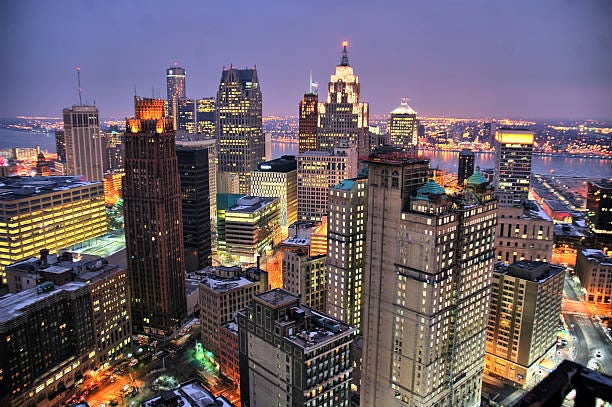
A view of downtown Detroit at dusk. Source: gettyimages.com
As I noted in the replay I posted Monday, a couple of years ago Detroit crossed a significant milestone in its revitalization – in 2023 it reported the first increase in the city’s population since 1950. It was a modest increase, a small jump from 631,514 people in 2022 to 633,221 in 2023. The added 1,707 people that year, an increase of just 0.27%, reversed the 72-year downward population spiral the city experienced after reaching its peak of nearly 1.9 million residents.
This is notable for a couple of reasons. First and foremost, Detroit has stood out nationally as the prime example of American urban decline for as long as its population has been falling. It had been argued by many urbanists as to whether Detroit may ever come back as a major city, becoming like many historical cities that were once great but today a shadow of their former selves. So far, in this decade, Detroit has shown that it can indeed recover, something that many doubted.
The other notable reason? The pace of hasn’t only endured over the last couple of years, it’s accelerated. In 2024 the U.S. Census Bureau’s American Community Survey one-year estimate showed 645,702 residents in Detroit, an increase of nearly 2% (almost 12,500 people) over the prior year. A 2% increase in population in one year is the same as a 20% increase over a decennial Census period; that’s approaching a boom level of growth.
That’s a remarkable turnaround for a city that was so closely identified with urban decline, for so long. I decided I wanted to dig into the numbers to see who’s at the forefront of the change, address how and where it’s happening, and if is sustainable.
Historical Background
I’ve promoted my own theory over the years that Detroit’s collapse was as much – if not moreso – a social collapse as an economic one. During the rise of the auto industry, little attention was given to making Detroit a successful, livable city. Much more was given to making it serve the needs of the auto industry and to be a profitable city. There were decisions made throughout much of Detroit’s early history with the auto industry that grew over the years, festered, and finally exploded as automation, the offshoring of jobs, and increased industry competition eroded the city’s economic advantage.
This is apparent when you compare Detroit’s 70-year population decline with peer manufacturing cities. Back in 2012 I posted this chart that examined a correlation between rising Black population between 1950-2010, and declining White population over the same period:
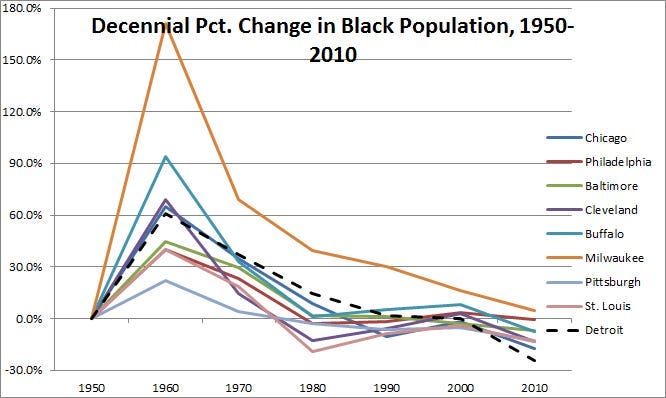
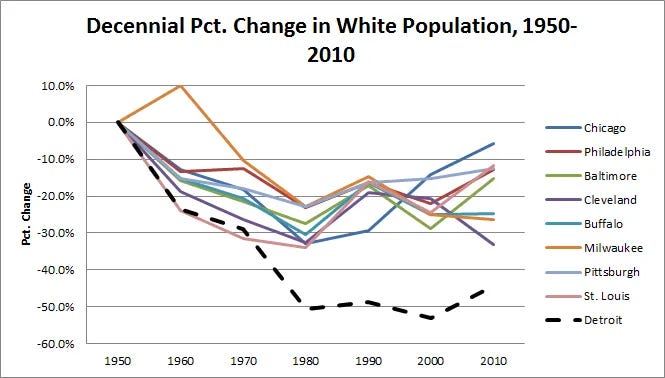
Detroit’s late 20th century gain in the number of Black residents is consistent with percentage gains in other cities in this analysis. However, its loss of white residents over the same period is substantially greater than the other cities – perhaps in a way that deindustrialization, suburbanization and other factors could describe on their own.
One possibility? I brought up this point in 2012:
“In 1918, a new city charter was established that led to the reorganization of local government to have Council members elected city-wide, instead of by wards. This governance system has been in place ever since, but is slated to end with the establishment of a new charter in 2013 that will now elect council members from seven districts and two at-large spots.
This has been a double-edged sword for Detroit. While it may have kept a lid on some of the possible corruption that could have happened, it likely created greater distance between residents and city government. I believe this led to two significant impacts. First, it allowed the influence of the auto industry to travel unfettered within local government through the first two-thirds of the 20th century, without the countervailing influence of local residents. Second, without representation and support, neighborhoods were unable to mature in Detroit as they had in other major cities. They never had champions at the local government level, as elected officials had to view the city in its entirety and abstractly, and not represent and develop a unique part of the city.”
Put another way, maybe because Detroit never had a machine-politics mayor like Chicago’s Richard J. Daley, or a strong law-and-order mayor like Philadelphia’s Frank Rizzo, it fared worse. Whatever the reason, Detroit’s population loss continued through the 2000s. The 2010 Census found that 25% of Detroit’s residents left the city over the previous decade. That was the largest decade decline in the city’s history.
Hitting bottom, getting up
The 2010s saw continued population loss in Detroit, much of it associated with the 2008 financial crisis that hit the auto industry and real estate very hard. Of course, the city’s municipal bankruptcy was a major factor also. By the end of the decade it became clear that Detroit could be entering a new phase – a possible prolonged period of revitalization that would not be necessarily connected to the fortunes of the auto industry.
Since 2020 there’s been significant demographic change in Detroit that did not register as population growth until 2023. The demographic makeup of the city was changing, while virtually no change was happening at the metropolitan level. See how the city and metro compare below:


If you wish to dig into absolute figures at the city and metro levels, see these tables below:


The Black-majority city of Detroit has seen continued population decline among its Black residents, but considerable growth among whites, Hispanics and Asians. And this change is happening as the metro area’s population has been at a virtual standstill for four years (actually, more like 50 years). Detroit’s lagged behind other cities and metros in attracting new Hispanic and Asian residents, but that gap seems to be shrinking. Detroit has also had a significant Middle Eastern population for more than a century, and while that group doesn’t show up in traditional Census demographic categories, it’s probably evident in the broad “Other” category to some extent.
What’s happening in Detroit seems to be comparable to turnarounds in two other former Black-majority cities, Atlanta and Washington, DC. Both cities had two-thirds Black majority populations in the 1990 Census, but increasing numbers of whites, Hispanics and Asians, along with increasing suburbanization of Black residents in both regions, fueled the demographic change. Additionally, one could explain growth in Atlanta and DC over that time due to the strengthening economy in both regions. The same can’t be said with any certainty about Detroit.
So what’s happening in Detroit is likely something unique among legacy cities like Detroit, even perhaps American cities in general. Why is it happening? I don’t know for sure. My best guess is that:
· Younger suburbanites are returning to the city, in the same way this happened in other cities nationwide in the early 2000s.
· Ex-pats are also returning to the city, either to take care of aging family members or moving into more affordable housing market.
If either or both are true, then this might lend more credence to my theory that Detroit’s population loss came about more from social factors, rather than economic ones.
I’ll follow this up soon with an analysis of where population change is being made in the Detroit, at the ZIP code level.
I'm certainly no urban expert. Did a lack of cooperation between the city government of Detroit and the county governments contribute to the problem?