Finding American Density
If people see they can maintain their quality of life at higher residential densities, I think they'll accept it. They just have to see how.

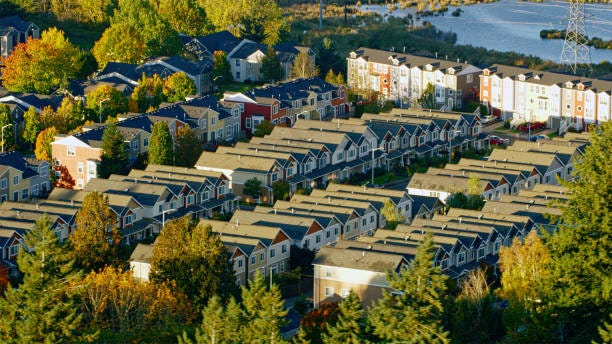
Maybe townhouses like this aren’t your thing. But allowing them in your community means you can enjoy the open spaces you have, and make your community a more sustainable one. Source: gettyimages.com
I think there’s a level of increased density that most Americans would be comfortable with. It just hasn’t been identified yet.
Density’s always been a touchy subject in America, a nation where people feel entitled to wide open spaces. But I’ve always felt even a nation as large as ours has its limits, and not everyone can be accommodated in expansive environments.
I think what most people who fear density are fearful of is limits to their own quality of life. The loss of privacy, open space, peace and quiet. It’s been stated many times and in many places, but Americans show that they like the energy, walkability and dynamism of dense environments, whether in U.S. cities like New York, San Francisco or Chicago, or in global cities like London, Paris and Tokyo. Many even like the human scale of a traditional college campus. But many Americans don’t see that as an every-day kind of living for most Americans. Why? I think many believe it puts a ceiling on their quality of life.
But I firmly believe we can achieve the quality of life people want at higher density levels than our nation’s been building for the last 75 years.
Let’s start by looking at density from a persons per square mile perspective. That seems to make the most sense, even if most people can’t tell really visualize it. Defining and quantifying density has always been a challenge to explain to laypeople. Most people can’t tell the difference between 5,000 and 7,000 people gathered together or envision a square mile in area. It’s all abstract. But people can define and quantify density (in terms of what they like and don’t like) on their street, their neighborhood, and in surrounding neighborhoods.
Take New York City. At the every-day-lived-experience level (i.e, small units like census tracts and ZIP codes), New York is without question the densest place in America. Manhattan is far and away the densest county (yes, it’s a county) with nearly 75,000 people per square mile. It’s not uncommon to find parts of Manhattan that work out to more than 100,000 people per square mile – even if there’s fewer than 100,000 people and far less land area than a square mile.
Beyond Manhattan, Brooklyn and the Bronx are the next densest NYC boroughs/counties, at 39,000 and 35,000 persons per square mile, respectively. Queens comes in at just over 22,000 per square mile, and Staten Island has the lowest density at just under 9,000 per square mile.
But New York is America’s density outlier, and never should be used as the singular example of density in the U.S.
In fact, density levels in the New York metro area drop dramatically once you exit New York City. Overall, the density of the New York metropolitan area in 2020 was 3,164 persons per square mile, substantially lower than the five borough’s 29,298 per square mile. That means that the suburban New York metro area – Long Island, the New York counties north of NYC, New Jersey and even parts of Pennsylvania – were built out at a far lower 1,819 per square mile, even when including far denser and still comfortable places.
My point is, there’s a higher level of density that can be achieved in U.S. metro areas, without losing out on quality of life.
I think most Americans are comfortable with a gross density that allows small-lot single-family homes on lots that offer privacy (i.e., 5,000-10,000sf max), interspersed with smaller multifamily buildings with anywhere from 2-6 units. That’s a gross density that works out to around 8,000 – 12,000 people per square mile at the “lived experience” level, and about 3,000 – 4,000 per square mile at the metro level. That’s significantly higher than gross densities in many Southern and Southwestern metros; in fact, there are core cities in the U.S. that are within or below my recommended level for metro areas. Atlanta (3,686), Phoenix (3,105), Charlotte (2,837), and Indianapolis (2,455) are all cities that could build at better densities, surrounded by suburbs that could do the same.
I’ll follow this up with a piece that shows how this can be accomplished and visuals of how increased density can be eased into our communities.