Getting Comfortable With Density
Higher residential density, and spaciousness and peace of mind, can coexist.

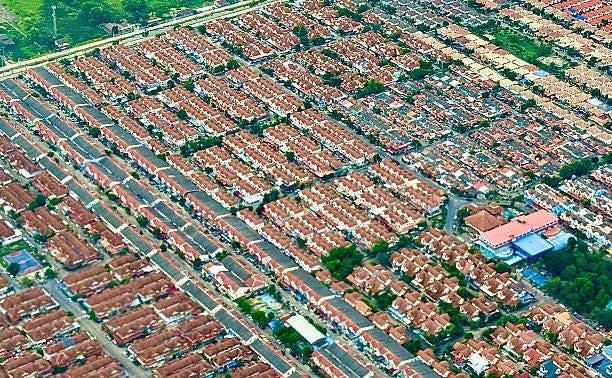
The residential development pictured here would represent a big increase in density in many U.S. metro areas. But trust me, it’s not hurting anyone. Source: gettyimages.com
I’ve been having some thoughts recently on how Americans view residential density, and land use and the built environment more generally. The questions I really have are: how do we get a larger slice of the American public to willingly accept higher levels of residential density? How can we find a comfortable level of residential density that appeals to the most people? How can we improve housing affordability without incurring the ire of NIMBYs?
This came to mind when I had an epiphany of sorts recently. There are lots of people who dislike density because of the associations they have with it – Manhattan-style high-rise or townhouse living; stifling traffic, crowded public transportation; so many daily interactions with strangers that make some people feel uncomfortable and thinking that crime could impact them at any moment; no place to get some peace of mind. That’s certainly one way of viewing density. But that’s based largely on vague impressions of New York City and other East Coast cities in terms of actual density, and perhaps some Midwestern/Rust Belt cities in terms of, well, discomfort.
The epiphany I had was that New York City was, is and always will be the density outlier of American cities because its density is an accident of history and geography. History because it was established prior to the development of railroads (only a handful of East Coast cities can say that), and geography because of the New York harbor.
Put another way, if there was no New York Bay fed by the Hudson River, no East River connecting to the Long Island Sound, New York would’ve had an overall density similar to Boston or Philadelphia. For an even closer comparison – it would’ve been like New Jersey just across the Hudson.
This map showing the number of persons per square kilometer in metro New York in 2010 shows what I mean:
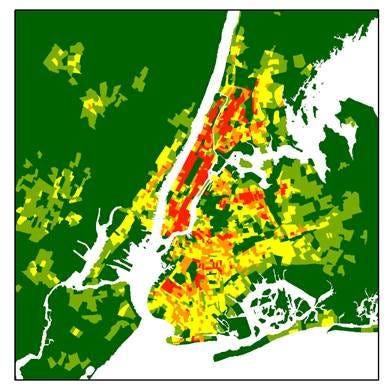
Source: liberallandscape.org
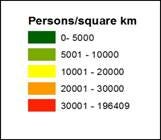
I know most Americans prefer a persons per square mile comparison, so here they are:
Dark Green – under 12,950 persons per square mile (ppsm)
Light Green – 12,950 ppsm – 25,900 ppsm
Yellow – 25,900 ppsm – 51,800 ppsm
Orange – 51,800 ppsm – 77,700 ppsm
Red – above 77,700 ppsm
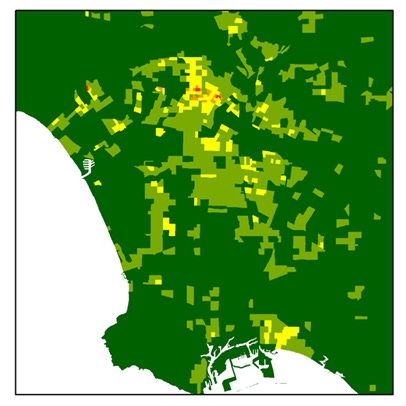
Compare New York to other metros, using the same scale. Here’s Los Angeles:
Here’s Chicago:
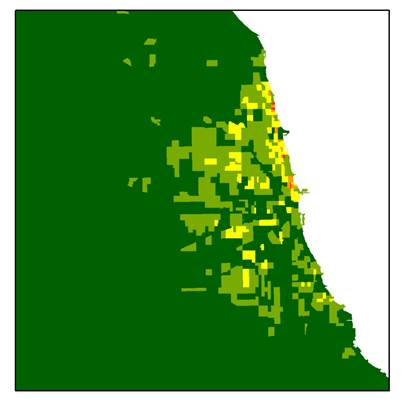
In 2020, Los Angeles happened to be the densest urbanized area in the nation (with more than one million people), at 7,476.3 people per square mile. Urbanized areas are contiguous, built-up areas of at least 50,000 people, calculated at the census tract level. They are distinct from metropolitan statistical areas, which are calculated at the county level and often include exurban and even some rural areas. New York’s urbanized area was third densest among those with a million-plus residents (San Francisco ranked ahead with 6,843 people per square mile, while Chicago ranked 12th at 3,709.2 people per square mile.
What’s interesting is that the Los Angeles and Chicago maps look similar to New York’s, minus Manhattan, Brooklyn, Queens and the Bronx. In fact, Los Angeles and Chicago have the same kind of dark green/light green/yellow mix of density that you see on the other side of the Hudson River in New Jersey.
Let’s focus on Hudson, Essex and Bergen counties in New Jersey. These counties comprise three of the four most populous counties in the state, with more than 2.5 million people in 2020. Together they cover 405 square miles of land area, giving them an overall density of nearly 6,300 per square mile. I’d argue that’s a general figure that most Americans would be comfortable with, if more housing were to be added in other metro areas. Hudson County, immediately west of New York City and including Jersey City, has a density of almost 16,000 people per square mile, nearly equaling New York City’s outer boroughs. Essex County, which includes Newark, is just under 7,000 people per square mile, and it has its share of comfortable, spacious suburbs. Bergen County is the least densely populated of the three, with 4,100 people per square mile. I’m guessing the terrain has something to do with that lower figure, but I’m sure there’s space to expand there.
My point is, we don’t have to recreate Manhattan to solve our housing affordability issues. There are numerous examples of communities that offer the spaciousness that many like, at density levels people would not expect. It just depends on how we choose to view the communities around us.
I think you are being too charitable in ascribing the discomfort many people feel with density to density per se. I still think it is that densiry is imprinted with with race and class status. To cite one example, most white people in Baltimore are not uncomfortable with the middle density of rowhouses. But that doesnt make them willing to live in a majority Black rowhouse neighborhood or stop the market from valuing the exact same rowhouse, built by the same builder during the same time period higher if it is in a majority white rowhouse neighborhood rather than one nearby that is majority Black. I just think we have to talk about and confront the racial and class issues openly and honestly to change that. I do have more hope for the younger generations than those of us who grew up at the height of segregation, although the permission for open racism given by the MAGA propaganda seems to be stirring latent racial resentment among younger white men.
I completely agree that we should have more of that middle density that most Americans are more comfortable with. I’d also argue that the fact that Manhattan prices are so high shows that there’s still enough Americans that do want that higher density that we should enable more of that as well. It is hard to predict a single number that says how much American demand there is at each of the different density levels. Which is why it seems like the best solution is to generously zone many areas and let the market figure out which areas have demand for that higher density and when that demand has been satisfied.