How Perceptions Impact Communities – Another Chicago Example
Can we ever try to understand Chicago as it is -- a safe place for many, a violent place for others -- but no different than other major U.S. cities?

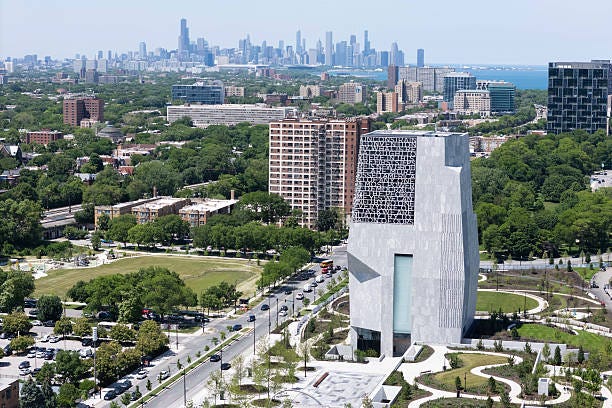
The Obama Presidential Center on June 3, 2026, just prior to its grand opening. It sits prominently on Chicago’s south lakefront, which has been undergoing a steady rebound. Source: gettyimages.com
(Note: It’s been tough to deliver regular content over the last couple of weeks as I continue to recover from illness. In-person and virtual visits to my team of doctors have taken up lots of my time, and I’m learning how much time and patience is needed to get back to 100%. I’m not there yet but I’m getting closer every day. In the meantime, I’ll contribute as much as I can when I can. – Pete)
This is long. You’ve been warned.
The Obama Presidential Center on June 3, 2026, just prior to its grand opening. It sits prominently on Chicago’s south lakefront, which has been undergoing a steady rebound. Source: gettyimages.com
Recently in my X/Twitter feed, I’ve seen a lot about Chicago. The grand opening of the Obama Presidential Center was certainly a major newsworthy event, and it was nice to see Chicago, and the South Side in particular, displayed as a focal point of the event.
Also, as we’ve entered summer, we’ve had strings of pleasant days that remind people that Chicago is unparalleled as a world-class destination (well, for three out of our four seasons). Summer brings out the best of the city – the events, the activities, the institutions, the restaurants, the architecture, the beautiful lakefront – and many people on X/Twitter are letting it be known. That’s great.
But then that was followed by several comments about Chicago’s crime, where the city just can’t shake its reputation. Here are some representative tweets:



Yeah, that’s nice.
Then came yesterday, when President Donald Trump decided he would do his best distraction work away from the failed Iran War effort to single out Chicago’s violent Juneteenth weekend. I’m not a Truth Social subscriber, so you’ll not find any screenshots of Trump’s comments from me. But according to The Independent, here’s what he said:
““At least 39 people injured, 4 dead, in Chicago weekend shootings,” the president wrote on his Truth Social platform late Monday.
“Governor Pritzker, I, as President, can fix this, FAST and Permanently. D.C., Memphis, New Orleans, all down to record lows, and quickly! CALL ME!””
And then, while boasting of the job the federal government has done in bringing down crime in Washington, DC, he said this about Chicago:
““I could make Chicago a safe City in ONE MONTH, in ONE YEAR, it would be one of the safest!!!””
If you say so, Mr. President. But how’s that working out for you?
There are a lot of people, within Chicago, or the metro area, or elsewhere, who seem to think that the city’s troubled violent neighborhoods virtually outnumber and surround the affluent parts, making anyone saying “Chicago is great!” sound ridiculous or irrelevant.
That’s not true. Chicago is indeed world-class in parts. It’s also dealing with serious violent crime challenges just like, and not out of line with, many major U.S. cities. In fact, I think there’s lots happening here that gets very little notice. That led me to make this comment:

Accurately understanding violent crime in Chicago
I’ve learned a couple of things regarding Chicago over the last 25 years or so. First, I’ve learned that Chicago’s perception as the nation’s most violent city is undeserved. I realize that it’s sensational for reporters to comment on deadly weekend shootings in Chicago by framing them like “at least seven people dead and 38 others injured over the weekend,” as the Independent did. Readers are stunned when they see absolute numbers like that, and rightfully so. But without any context, it overstates the problem.
Consider this. In 2025, Chicago reported 416 homicides. On its own it’s a staggering figure. I haven’t been able to confirm it, but I’d bet Chicago had the highest number of total homicides in any U.S. city in 2025. Meanwhile, Milwaukee reported 142, Atlanta 98, and Cincinnati just 61. That might mean to many people that Milwaukee, Atlanta and Cincinnati are considerably safer (homicide-wise) than Chicago. But it really means that they are considerably smaller than Chicago. In 2024 Chicago had 2.7 million people; Milwaukee had 563,000, Atlanta 520,000, Cincinnati only 315,000. If you normalize homicides in each city at a rate per 100,000 residents using their 2024 population – a statistic the FBI and police districts across the country have used to compare numbers for decades – the picture looks quite different.
How so? In 2025, Chicago reported 15.34 homicides per 100,000 people. Yet that number in Milwaukee was 25.20, 18.84 in Atlanta, and 19.37 in Cincinnati – all much higher than Chicago. Milwaukee, Atlanta and Cincinnati don’t report “x homicides and y wounded over z shootings during the weekend” because those numbers are never as sensational as they would be on a weekend in Chicago. Normalizing the data makes the argument that Chicago is much safer than Milwaukee, Atlanta or Cincinnati, even though Chicago is 5-9 times larger than the other cities.
Chicago is changing in ways other American cities simply aren’t
I’ve also learned that it’s well past time for Chicagoans and others to put aside the North/West/South side divides and look at the city from an entirely different perspective – lakefront and inland areas. Chicago is clearly one kind of city on the lakefront, and another away from it. The south lakefront has seen a steady but substantial revitalization that I’ve commented on frequently.
Back in 2021, I co-authored an opinion article with Ed Zotti and Mike Rothschild in Crain’s Chicago Business (paywalled) that I later posted on this Substack. Here’s what we said about the south lakefront then:
“In the last decade, however, the south lakefront has turned the corner. To summarize the trends:
The south lakefront (and the lakefront generally) is gaining people, while interior neighborhoods are losing them. The growing south lakefront communities identified in the map below gained a total of 20,000 people between 2010 and 2020, split roughly evenly among the city’s major ethnic groups. The area is becoming more diverse as a result, but remains predominantly Black (69% now vs. 74% in 2010). In contrast, the interior communities throughout the city, depicted in yellow and orange on the map, lost 80,000 Black people and 2,500 whites.”
Here’s another noteworthy quote:
“The south lakefront still has more violent crime than the North Side, but current rates there are comparable to what many North Side neighborhoods experienced 20 years ago. Crime remains a serious concern, but is not the barrier to neighborhood renewal it once was.”
And, countering the general “gentrification and displacement” narrative that’s prevailed throughout the 21st century, we found something different was happening in Chicago:
“We believe the south lakefront is where the north lakefront was in the early 1980s and, given modest assistance, will follow the same path, with luck becoming the first large-scale community of upper-middle-class Black professionals in any major U.S. city. The importance of such a development, for both Black people and Chicago, cannot be overstated.”
That growth pattern has continued, but it fails to get the recognition it deserves.
Who’s safe in Chicago?
Anyway, I made an assertion in my tweet that I think few people know or understand. Chicago is not an island of affluence on the North Side surrounded by crime west of Western Avenue and south of Cermak Road. So I sought out to prove it.
First, I want to state the obvious: I’m using homicide rates as an indicator of relative public safety in this analysis. But to be clear, homicide rate should not be viewed as an overall indicator of public safety. It’s not. Other crimes fit nto the mix: rape, aggravated assault, armed robbery. One does not have to die to deem a place unsafe. People survive very violent acts every day and carry that with them throughout their lives. However, homicide rate is a handy metric that’s easily understandable as we try to gauge potential safety concerns between places.
Second, I want to designate what I’m calling “lakefront” and “inland” in a Chicago context. Using Chicago’s Community Areas, the city’s community designations that have been used for consistent demographic purposes since the 1920’s, I’ll show you what I’m highlighting as lakefront and inland for Chicago:
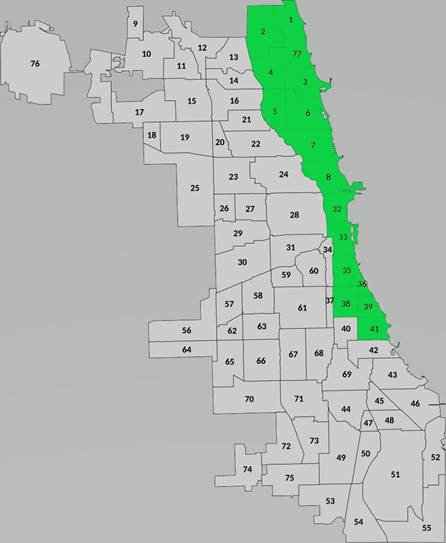
The 16 community areas highlighted in green above, which includes dozens more neighborhoods within each community area, are what I’d call Chicago’s lakefront communities. Those in gray I’d call the city’s inland areas. One note: the tweet I wrote said the lakefront extended from Rogers Park (#1 at the top) to South Shore (#46 on the bottom left). I’ve since pulled out three community areas, Washington Park (#40), Woodlawn (#42), and South Shore (#46). After sifting through the data I found that while they have lower homicide rates than they used to, they still have higher rates relative to the others in the lakefront category.
I’d also break down the lakefront communities into three categories – north lakefront, the Loop (downtown Chicago), and south lakefront. You can see those in the map below. The north lakefront is in green, the Loop is a standalone community in blue, and the south lakefront in light blue:
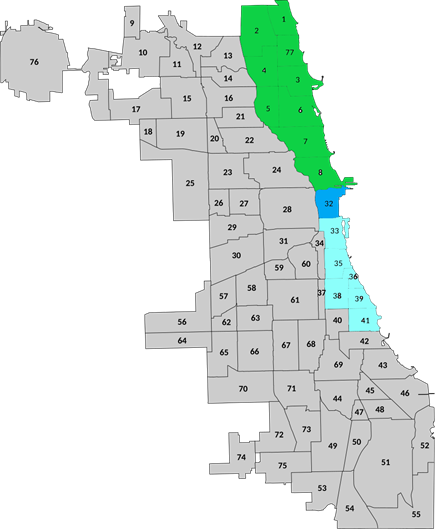
Without question, these areas have been the densest, most valuable and probably most desirable neighborhoods for most of Chicago’s history. That’s certainly been true for the north lakefront and the Loop. Since the 1980s the north lakefront has gone through a remarkable transformation as (mostly) white working-class and middle-class neighborhoods were inhabited by young professionals, intrigued and entranced by the access and amenities the north lakefront afforded. It’s continued to this day, fueled by a steady stream of Big Ten college graduates annually who choose Chicago to start their careers and enjoy the urban experience.
The south lakefront was once an affluent section of the city, but that changed with the growth of manufacturing, particularly in the steel and transportation industries, that required hundreds of thousands of workers. In the early 20th century immigrants came from eastern, central and southern Europe to take those jobs and establish new lives in Chicago. So did tens of thousands of Blacks escaping the Jim Crow South at the time. Once they arrived, individual and collective real estate decisions and real estate practices largely relegated the city’s Black population within the south lakefront area, when it was known as the “Black Belt”.
Beginning in the middle of the 20th century, Black residents started moving outward from the Black Belt to get away from the overcrowding, and to seek out calmer, quieter and safer neighborhoods. That, and the explosion of suburbia beyond Chicago’s city limits, set off the pattern that many have called “white flight”.
One way of seeing how different Chicago’s lakefront neighborhoods are from its inland ones is to look at the densities of lakefront and inland areas. This table shows the breakdown for the city:

As of 2024, Chicago had 2,711,226 residents within its 231 square miles of land area. The lakefront communities make up just under 14% of Chicago’s land area but comprise 29% of the city’s population. On a per square mile basis, the lakefront communities have 2.41 times the density of the rest of the city. There are so many other things we could find out about Chicago using this framing, but I’ll leave that to future posts. This one’s about violent crime.
I checked out the ABC 7 Chicago Neighborhood Safety Tracker, which summarizes monthly Chicago Police Department crime statistics and sorts the data by the city’s 77 community areas. ABC 7 Chicago updates the data monthly and presents it in rolling twelve-month periods. Here’s the number of homicides, using the same framing as the density figures above, that took place over the last 12 months, between June 14, 2025, and June 14, 2026:

To better understand this, let me show you how the city overall fared:

My numbers differ slightly from the ABC 7 Chicago’s tracker because they’re using different population figures than I am; my numbers are from the U.S. Census’ 2020-2024 Five-Year American Community Survey estimates. Even still, the citywide homicide rate I have of 16.38 homicides per 100,000 residents is in line with ABC 7 Chicago’s 16.7 per 100,000 rate. That gives you a sense of the citywide nature of homicides. And yes, it’s not good. That rate is slightly up from the 15.34 rate I referenced in 2025 earlier here.
Here’s another approach. In 2024 Chicago had a 17.47 per 100,000 homicide rate. The 2025 data by city has not yet been released. But if you compare Chicago’s rate with the published data by city in the Federal Bureau of Investigations’ 2024 Uniform Crime Report (UCR , you’d find that Chicago ranked 22nd out of the 200 largest cities the FBI had data for. Notable cities with higher homicide rates than Chicago in 2024 include Kansas City (27.56), Washington, DC (25.49), Cincinnati (21.82), Indianapolis (19.98), and Minneapolis (17.95).
Yet look at how the 2026 Chicago lakefront community area data compares with the citywide 2024 UCR data. Combined, Chicago’s lakefront communities have a rate 5.28 homicides per 100,000 people – less than Seattle (6.84), or Austin (6.60).
I note Seattle and Austin because their 2024 population in the UCR (760,000 for Seattle, 984,000 for Austin) were comparable to the 776,000 along Chicago’s lakefront, yet they had higher homicide rates. What’s more, the ten cities that averaged a similar homicide rate in 2024 as Chicago’s lakefront did over the last 12 months were substantially smaller and less dense than the Chicago lakefront. See here:

Key Takeaways
That’s an awful lot of numbers dropped into a very long Substack post. However, I’d distill this down to the following takeaways:
· Chicago’s lakefront neighborhoods, including the south lakefront, are as safe as any place – large or small, densely populated or not – in the U.S. Nearly 800,000 people live in a densely populated area slightly larger than Manhattan. On its own, Chicago’s lakefront homicide rate of 5.28 per 100,000 would’ve ranked 105th out of the 200 large cities the FBI tracks annually (not to be confused with all the 200 largest cities; a handful of large cities are missing). Put another way: Chicago’s lakefront communities have a homicide rate on par with midsized U.S. cities that are one-fourth or one-fifth its size.
· Chicago’s north lakefront and downtown stand out as especially safe. On its own, the north lakefront homicide rate would rank it well in the bottom half of the FBI’s Unified Crime Report rankings.
· Chicago’s south lakefront is getting safer, quickly. Chicago’s south lakefront was once plagued with the same violent crime that Chicago has been cited for. But it’s dramatically fallen since the 2010s as the area has found the eyes of people priced out of the north lakefront.
· There are still troubling challenges with violent crime in the rest of Chicago. Not all of Chicago’s inland neighborhoods are facing violent crime challenges, and that should be noted. Community areas like Logan Square, West Town (which includes Bucktown and Wicker Park), the Near West Side and Humboldt Park could’ve been included in the lakefront analysis, but were not. That said, the balance of the city has considerable violent crime concerns – but it’s on par with other large cities experience nationwide.
· Chicago’s south lakefront transformation, which saw a drop in violent crime and an influx of new residents without significant displacement, could be a model for other cities. Somehow, Chicago has found a way to revitalize communities at a steadier, more deliberate pace, and in a more equitable fashion. Part of that was because of the actions of local government over the years, part of it was the work of community activists and interests, and part of it was due to larger economic factors that influenced individual and collective decision-making. But it’s worth investigating.
There is truly something for us all to learn from Chicago’s approach.
Amen, Pete. In Baltimore we experience the same stereotyping. Many place blame for that on The Wire, but the stereotypes of majority Black cities, Black neighborhoods and Black residents (especially youth) run much deeper than the Wire. Also like Chicago, there are waterfront and interior neighborhoods with very different, conditions and crime rates and perceptions of safety that are rarely acknowledged by the test of the country (or even our own suburbanites).
Now even in the most disadvantaged and historically most violent neighborhoods, the murder rate has been dramatically reduced to levels not seen in 50 years. Not by Trump and his troops, or Martin O’Malley’s zero tolerance policing but by a Group Violence Reduction Strategy modeled on public health approaches and concerted work from City Hall to the neighborhood grassroots.
Even though I mostly agree with this post, I don't think its quite fair to compare the best part of Chicago (North Lakefront) to other cities. Instead, it would make more sense to compare it to the good parts of other cities. So for example, how does its murder rate compare to Atlanta's Buckhead or New York's Upper East/West Sides?