More On The Shunning
The Shunning: the socio/psychological response that has social, psychological -- and economic -- impacts.

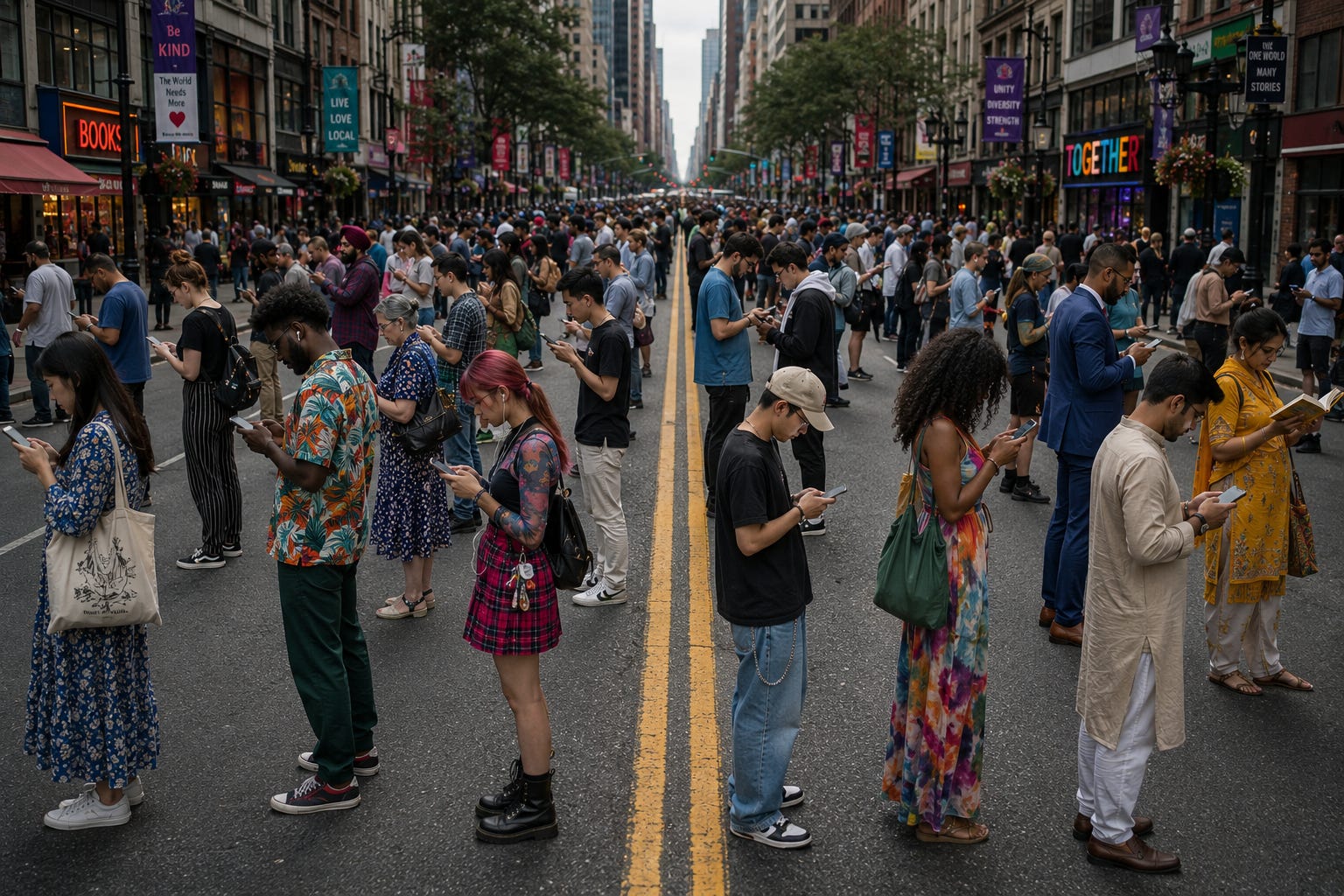
Source: image created by chatgpt.com
The last week has been incredible for the Corner Side Yard! And I have you to thank for it.
Thousands of new readers have found CSY since I posted two articles this week: Midwest/Rust Belt Downtown Perceptions on May 3, and St. Louis Is Experiencing The “Shunning” on May 5. Within six days both entered the top five of the most popular CSY posts (out of about 200 posted since April 2024). Pageviews are up substantially – this week pageviews are more than triple my previous four-week average. Lots of good (and not so good) responses in the comment section. I’ve added a month’s worth of new subscribers in the last six days!
It’s clear that the themes of both pieces resonated with readers and spread the word. Thank you so much, and I invite all new readers and followers to subscribe!
About the themes…
This all started when I saw a series on Downtown St. Louis published last week by the St. Louis Post-Dispatch. St. Louis’ downtown is suffering from the real and perceived impacts of crime, office closures and relocations, the loss of major sports teams, retail and commercial uses, the impact of remote work – all the markers of the “urban doom loop”. The Post-Dispatch takes a hard look at downtown St. Louis. My reading of it was that their downtown would not economically flourish unless there was a concomitant effort to change perceptions of it first.
The May 3 article brought up a point I made about Midwestern cities long ago. I’m generalizing here, but I’ve argued that older cities on the East Coast have managed to hold onto positive perceptions of their downtown cores. Even when East Coast cities were viewed at their worst (say, in the ‘70s), there still was no doubt that they were dominant, multifaceted centers of commerce. Younger cities in the Sun Belt and West Coast have fairly benign or neutral perceptions of their downtowns. They don’t symbolize economic power as much as showcase the rising affluence of growing regions.
Many Midwestern cities had downtowns that exhibited both traits. However, when automation and globalization remade America’s manufacturing economy, ushering in a post-manufacturing malaise, Midwestern downtowns quickly lost their perceptions as centers of commerce. The expansion of suburban development took place nationally but its impacts were exacerbated in the Midwest – the one American region where the representations of old/new, manufacturing/knowledge, city/suburb had hard dividing lines at the city limits. The manufacturing economy waned, while suburban influence, fueled by rising economic sectors, grew stronger. As a result, strong negative perceptions of Midwestern downtowns developed and became the dominant narrative about them. The narrative ended up being applied to entire cities as they entered their post-manufacturing economy eras.
The May 5 article looked at Detroit’s experience as a shunned city. I quoted the former Executive of suburban Oakland County, L. Brooks Patterson, from a 2014 New Yorker article. The interview came during the midst of Detroit’s municipal bankruptcy filing. Patterson was born and raised in Detroit and earned a J.D. from the University of Detroit in 1967 before settling in Detroit’s northern suburbs. What he said about Detroit was not pretty.
But Detroit’s come a long way since its bankruptcy, and I wrote about how renewed engagement from metro Detroiters – involvement from corporate and institutional leadership – played a big role.
I typically haven’t generated a lot of comments on my articles, but I got a good number for this piece. Most were positive. Many offered an acknowledgement that this was indeed a pattern and that they were unaware of it. Others spoke about similar dynamics in other cities (Baltimore being a close comparison to St. Louis).
But there were a lot of negative comments that illustrated how wide the chasm is in metro St. Louis. The Post-Dispatch’s first entry of the series referred to a report released last December by the downtown group Explore St. Louis. A section of the report has the heading “St. Louisans Named Locals as St. Louis’s Biggest Critics,” and I think that referred to city and suburban St. Louisans alike.
The Shunning is real
I believe the Shunning is a socio/psychological response that has social, psychological, and ultimately economic impacts. Last year I interviewed Tonika Lewis Johnson, a Chicagoan from the Englewood neighborhood on the city’s South Side. Frustrated with the negative connotations that affect her neighborhood and indeed the entire section of the city where it’s located, she did an artistic and journalistic exploration that ultimately earned her a MacArthur Fellows Grant last fall.
There are versions of the Shunning that happen in every metro area. South Dallas, South Los Angeles and West Las Vegas have, or continue to, experienced the Shunning in recent decades. But steady economic growth, and population growth that’s changing older demographic patterns, means it doesn’t factor into the calculus of the cities the way they do in the Midwest.
The only Midwestern cities that can say they mostly avoided the Shunning might be Columbus, Indianapolis, Kansas City and Omaha. That’s because each metro area emulated the Sun Belt pattern of expansive annexations or (in Indianapolis’ case) city-county consolidation. That shifted each region’s development focus – and perceptions – away from downtown and urban cores and toward newer suburban-like development on the edges. But those efforts did little to stop inner city decline, only to avert our eyes from it. The pre-Unigov portion of Indianapolis (i.e., the old city) had a 33 percent decline in population between 1960-2020. The old city represents about a third of consolidated city’s population. But the old city’s demographic and economic profile likely look more like St. Louis City than most Indianapolis residents would admit.
An analysis a couple months ago by Substacker Dion Thompson-Davoli took a similar tack, looking at population change for the 1945 version of Kansas City (almost 60 square miles) in 1950 and in 2022. Old Kansas City’s population peaked in 1950 at 430,535 people. Seventy-two years later, the population of Old KC fell to 187,902 – a loss of 56 percent. Meanwhile, the new Kansas City has grown to 319 square miles, with a population of about 510,000 in 2022. The people within the 239 square miles added to Kansas City now outnumber the old city residents by a 1.7:1 ratio, and the inner portions of the city struggle with vacant and abandoned properties.
St. Louis in a class of its own
All that said, St. Louis has experienced the Shunning in an acute way. If I were to rank the 16 largest Midwestern metros (more than one million people) by my perception of shunning in tiers, it might look like this:
Tier 1:
St. Louis
Milwaukee
Cleveland
Detroit
Chicago
Tier 2:
Minneapolis/St. Paul
Columbus
Indianapolis
Kansas City
Tier 3:
Buffalo
Cincinnati
Rochester
Pittsburgh
Louisville
Grand Rapids
Omaha
I can’t say I have equal knowledge or information about all the metros. But I’d say the tier 1 metros are the ones most negatively impacted by the Shunning (although I could see Chicago being in tier 2 because of downtown and north lakefront development over the last 50 years). Tier 2 metros are a mix of earlier-discussed annexation/consolidation cities, and a Twin Cities metro that’s had consistent growth that’s probably ameliorated some shunning. The tier 3 metros are smaller and I’m less familiar with them, but I know there’s been a level of shunning towards them. I’d also wager there’s a pretty strong correlation between higher Black populations and the level of shunning.
Detroit turned the corner, but the impacts linger
I’ve said before: Detroit was shunned and suffered economically because of it. Early efforts at revitalization didn’t succeed because they did not have the faith and confidence of those with resentments. With the 2013 bankruptcy, corporate and nonprofit leadership got engaged and understood the city was worth saving but it would not fix itself. That was a pivotal moment that undergirds Detroit’s rebound now.
But the feelings left from the shunning can linger. A strange conversation took place on X/Twitter this week among Detroit Pistons fans. It started with a comment about whether Pistons fans use the nickname” the Stones” to identify the team. From here I’ll let X’s Grok summarize the discussion:
“Social media users argue over the usage of ‘The Stones’ as a nickname for the Detroit Pistons, with some claiming it is common among metro Detroit or suburban fans while others, especially from Detroit proper or northern Michigan, insist they have never heard or used it. Discussions distinguish between ‘Detroit-Detroit’ city residents and those on the other side of 8 Mile, referencing personal experiences and past coverage.”
This might seem irrelevant or meaningless to many. But I think it is an example of the kind of isolation and insulation that results from the Shunning. A term commonly heard on the suburban side of the city boundary is found to be unheard of by many city residents. It becomes the source of a heated debate. But what does it really mean? It means that there have been decades of isolation and insulation between city and suburban residents – so much so that people on either side are wondering, “what the hell are they thinking?”
Several years ago I wrote a sentence with a depth of meaning I didn’t completely understand then. But I understand it more with every passing day. Around 2013-2014 I wrote “there is no isolation without insulation.” Insulation creates isolation, and has downstream impacts that show up in education, employment, health outcomes, economic well-being, and more.
And it can be at the heart of use or non-use of a basketball team’s nickname.