Preparing For The Climate Migrants
Cincinnati’s taken the first leap on this. Other Midwest cities may be next.

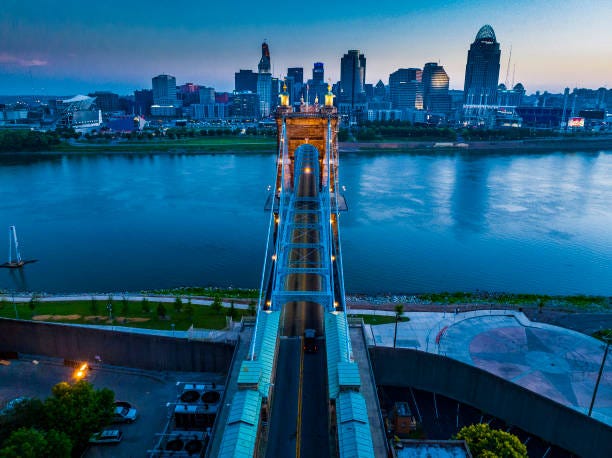
Aerial view of downtown Cincinnati, OH, and the water source that feeds it — the Ohio River. Source: gettyimages.com
In yesterday’s post I referenced a post I wrote nearly two years ago about Hurricane Helene’s destruction in the southern Appalachians, 400 miles inland from the Gulf coast. In both articles I referred to a quote by Ernest Hemingway in his book The Sun Also Rises. In it, a character is asked how he went bankrupt, and he says, “Two ways. Gradually, then suddenly.” My point has been that’s how the U.S. has approached climate change and will likely continue to do so. I can’t think of a better metaphor to explain it.
The release of a new policy document last week signals the pace to face climate change is escalating.
Last week, the City of Cincinnati’s Office of Environment and Sustainability released a plan that is, from what I’ve seen, the first of its kind in the U.S. It frames sustainability in an entirely different way than the traditional adaptability and resilience that’s been done for years.
It’s a major step that acknowledges that climate change will produce winners and losers. Cincinnati looked at the state of climate change in the U.S. Their assessment – Cincinnati will be a climate change winner, and they better prepare for it.
Cincinnati’s Climate Change Mitigation Plan, starts the plan by saying something that’s been uttered by many but never really spoken out loud:
“In a time of intensifying climate pressures, the impacts of climate change influence where people move. People are relocating from highly impacted area, like those facing extreme heat or coastal flooding, to areas they view as safer. These people, called climate migrants, are reshaping migration flows in the U.S. and abroad.
As migration patterns shift and people move to avoid the worst impacts of climate change, Cincinnati may be positioned to receive newcomers.”
Cities across the country have been preparing sustainability plans for years, usually with the intent of making sure they become more resilient against their pressing climate impacts. Usually that means investing in infrastructure, with the kind of infrastructure needed being determined by a city’s primary climate impact (coastal flooding, hurricanes, drought and wildfires, and more).
This has worked best in the regions of the country that have faced one or more of these climate impacts and chosen to protect themselves from further destruction. California’s wildfires, for example, has led to what might be the nation’s largest fire protection system. In Florida, agencies like the South Florida Water Management District work ceaselessly to protect against coastal flooding, and the statewide Resilient Florida Program demonstrates the strong commitment the state is making to protecting its shoreline.
California, Florida and many other states across the country are increasing their commitment to fight back against climate change. But Cincinnati, while still being impacted by climate change, implies that highly impacted areas will not be able to keep pace with climate change, and some people will relocate in the process.
Cincinnati’s plan touts the city’s amenities to attract climate migrants (affordability, strong economy, bustling neighborhoods, ample water supply). The city also acknowledges, subtly, that the climate change challenges it faces are manageable. High heat and humidity, excess precipitation, and river flooding can be handled.
The plan’s authors present some population growth scenarios on how many people, including climate migrants, will relocate to Cincinnati over the next 25 years. But no one really knows. Whatever the case, Cincinnati wants to let possible climate migrants know they’re welcome.
Hey, we might not be too far from cities like Cincinnati marketing this, like how tourism and convention bureaus in the Sun Belt regularly show commercials in Midwest cities in winter. You see billboards that say something like, “Freezing? In Tampa, today’s regular high temperature is 75°.” Most Midwesterners sort of roll their eyes. But later, they may plan that winter vacation and decide they like to move there and experience that year-round.
The Midwest version of that might be:
“Water restrictions getting you down? Coastal flooding ruining your beaches? Homeowner insurance skyrocketing? In Cincinnati, we have amazing affordability, charming neighborhoods, a great downtown – and plenty of fresh water.”
It could happen.