The Rust Belt Ricochet?
When rent-seeking looks like an economic trend.

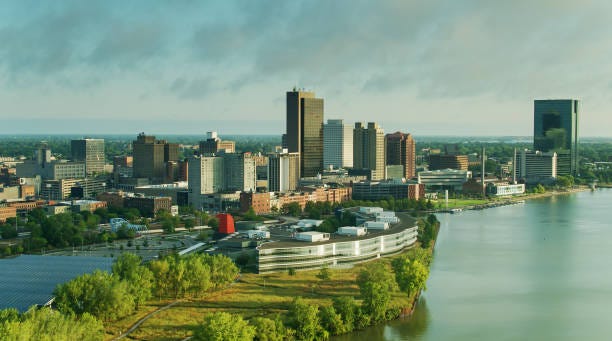
A view of downtown Toledo, OH, one of many Midwestern cities that are gaining in domestic in-migration because of its affordability. But is that a sustainable revitalization path? Source: gettyimages.com
It’s no secret that the early 2000s were not kind to Detroit.
Back then, in the runup to what would be the 2008 financial crisis, housing prices fell dramatically. Prices fell for several years in Detroit after the financial crisis kicked in as the City’s finances were wracked by corruption and reckless municipal spending. Of course, that led to Detroit’s municipal bankruptcy in 2013. That was when the City said it had $18 billion in debt that it could not afford to repay.
One of the things that developed in Detroit at the time was a bit of a cottage industry. People who were fed up with high housing costs in other parts of the country saw thousands of modest homes available for $10,000, $1,000, even $1. There were buyers who were ready to roll the dice and pay cash for homes, sight unseen. I’m sure there were many buyers who believed they were just a year or two away from flipping a $10,000 investment into a $50,000 sale. I don’t have exact data on this, but in most cases that didn’t happen. Buyers soon realized two sad facts: renovation costs far exceeded the purchase price, and no banks would loan to buyers wishing to renovate homes in such a dour market. Many homes ended up demolished.
While reading this story about recently rising in-migration to the Midwest, I was reminded of this.
Here’s what Atlantic writer Olga Khazan had to say about this:
“According to migration data, the cool thing to do now is put on your parka and move to the Midwest. Rockford, Illinois, a 150,000-person town an hour and 30 minutes from Chicago, was the most popular city for home shoppers last year, according to a Zillow algorithm that tracks home-value growth, how quickly houses sell, how many people from outside a given city are searching for homes there, and other factors. Dearborn, Michigan, and Toledo, Ohio, made Zillow’s top five. According to United Van Lines, one of the most popular states for inbound movers in 2025 was Minnesota; the state gained more people than it lost that year for the first time since 2017. Last year, a researcher at Harvard’s Joint Center for Housing Studies found that several midwestern states, including Missouri, Indiana, and Wisconsin, switched from losing residents before the pandemic to gaining residents after it.
Daryl Fairweather, the chief economist at Redfin, told me that according to company data, searches have increased for homes in several cities in the Midwest and upstate New York. These are the kinds of places, she said, that “people didn’t move into pre-pandemic or during the pandemic.” The company’s data also show that, compared with 2022, more people now are moving to Milwaukee, Cincinnati, Grand Rapids, Albany, and South Bend, Indiana. (Fairweather herself moved to Wisconsin from Seattle a few years ago.) Edward Glaeser, an economist at Harvard, told me that Columbus and Indianapolis are also popping up as affordable cities attracting newcomers.
Meanwhile, record numbers of people are leaving cities in the Sun Belt—a region that includes much of the southern United States.”
As much as I want the Midwest to become a desirable destination for new residents, as much as I believe it can become such a destination again, I don’t completely buy this.
Sure, there are a bunch of people who became fed up with the rapid rise in housing prices in other cities across the country. The Covid pandemic opened new avenues for remote and hybrid working that freed people from having to actually live where they work.
For those who do this, it makes perfect sense. But this doesn’t seem to be sustainable; in fact, it seems fleeting, ephemeral.
Why? I imagine many of the buyers in these cities are rent-seekers, finding a way to more wisely spend (and save) on housing, while not necessarily contributing to the economic fortunes of the region.
The only way it makes sense as a revitalization strategy for the region is that newcomers sell the region to friends and neighbors where they came from, to help them build something in their new home. If there’s an economic connection to it, I could see it. But this may be more of a quality-of-life improvement adjustment for many, and less a cultural or economic trend.
Khazan admits as much in her article. The Midwest, she says, “has been dismissed as boring, forgettable, nice but way too cold. Since practically the invention of air-conditioning, Americans have been leaving snowy northern states for warm places such as Florida, Texas, and Arizona—a trend that accelerated rapidly during the coronavirus pandemic.” True, and that hasn’t changed. It can change, but there has to be a “pull” that drives the region’s growth, not a “push” because of a lack of affordability.
That’s still possible, but this isn’t it.