"Together We Fill Gaps"
The coastal cities get expensive and the wealthy depart for Miami and Austin. Is that any different than relocating from the city to suburbs?

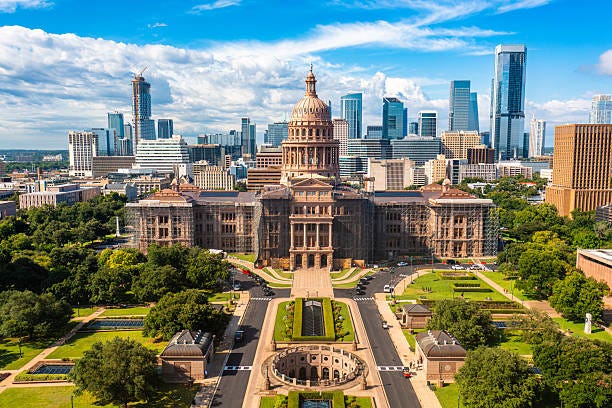
The Texas State Capitol and skyline of Austin, TX. Source: gettyimages.com
I’ve always believed that core cities and their surrounding suburbs have a relationship with each other, akin to a spousal or parent-child relationship. In the good-case scenarios, the core city and suburbs get along – jobs and amenities like entertainment, institutions, major gathering spaces cluster in the city, and comfortable, quiet residential areas cluster in the suburbs. In the bad-case scenarios, the core city and suburbs resent each other – city advocates resent the suburbs for siphoning off people and tax revenues, and for unsustainable sprawl. Suburban advocates resent core cities for high taxes that fund public school systems that barely improve, don’t eliminate issues like crime and homelessness, and have become completely unaffordable in the process. In the worst cases, there’s effectively a divorce or estrangement between the two: both sides agree to coexist, if not intermingle. There’s a good movie quote for this. In Rocky, boxer Rocky Balboa explains why he and girlfriend Adrian get along: “She’s got gaps, I got gaps, together we fill gaps”.
But there comes a time when both sides start believing they can survive without the other, even thrive. Cities across the country saw their suburbs socially, economically and mentally withdraw from cities in the ‘70s and ‘80s. Cities responded with their own backlash of sorts in the ‘90s and 2000s as many experienced solid revitalizations.
City and suburban advocates continue to play this out, in some form. Perhaps cities and suburbs will always believe that maybe they can survive without the other. But neither can thrive. Cities depend on suburbs, and suburbs depend on cities.
Reading Richard Florida’s recent essay posted in the Wall Street Journal last week, on the rise the nation’s wealthiest to depart from expensive, high-tax cities for lower-taxed, less expensive, less crowded places, I had the same thinking. It’s the same thing as the city/suburb dynamic, writ large – at a national, even global scale.
Florida noted how many in the one percent (and 0.1% and .01%) are leaving expensive, high-tax cities for cheaper and more affordable locales. Miami and Austin were two of the biggest beneficiaries of this trend, with tech types choosing Austin and financial folks heading to Miami. Ken Griffin made a lot of noise when he moved himself and his hedge fund Citadel to Miami in 2022. Griffin cited Chicago’s crime rate as well as high taxes.
Griffin and other elites are doing this because they’re less tethered to cities than at any time in modern history. For centuries the wealthy who generated a profit from where they lived simply dealt with the pros and cons of place as best as they could. But the wealth generated during the late 19th and early 20th centuries gave rise to industrialists with extreme wealth, and they were able to develop networks with other wealthy entrepreneurs so they could advocate for what they wanted. Think J.P. Morgan in New York City, John D. Rockefeller in Cleveland, and Andrew Mellon in Pittsburgh. In those cities the industrialists became benefactors of their home cities because making their cities better was good for business.
Moving because of high taxes or poor services isn’t new. I’d argue that relationship began to fray at the same time post-WWII cities saw their decline and the suburbs saw their rise. Factories followed workers to the suburbs. Corporations sought lower taxes by moving south, and then offshore.
Today the wealthy are doing it because digital technology allows people to put greater distance between where they work and where they live. Covid hit, and when virtual meetings became the norm, it seemed like the end was near for cities.
Today we realize now this wasn’t the end for cities. They’ve seen this happen before. They’ve learned to adapt.
Florida, however, does call out an added dimension to this. He notes that the wealthy have been behind this emergence of “luxury tax havens,” where cities like Miami and Austin (and Dubai) attract the wealthy to save money and run their businesses.
Now the wealthy are finding out that the “luxury tax havens” haven’t really developed as, using his term, “full-spectrum cities.” They weren’t built to accommodate the needs of the wealthy (at least on a permanent basis), and they weren’t necessarily built to accommodate the needs of the top 20% either – the managers and professionals who help the elite get what they want. Surprisingly, the issues that came to define large cities – high-priced housing, congestion, crime – were apparent in their new homes. Worse, things were accelerating because many luxury tax havens didn’t invest in the physical infrastructure, public services – and most importantly, the social infrastructure – that made cities work despite their flaws.
Here, Florida says this is the lesson the wealthy are learning:
“These lifestyle tax havens do not replace the great hubs. They are satellites in their orbit, part of the networks that form around them. Miami is a critical node in New York’s financial network. Austin operates as a satellite of San Francisco’s tech network. Dubai plays a similar role for London and the financial centers of Europe and Asia…
The model works well enough for wealthy residents who can buy private solutions—housing, education, transportation, security. For empty-nesters and young professionals without children, the trade-offs may be manageable. For families, they are far more consequential. And for service workers—the people who staff hospitals, schools, restaurants and local government—the barriers are often insurmountable. When the people who make a city run cannot afford to live there, the city itself begins to fray.”
Isn’t that what we learned as people move from cities to suburbs?
I think a big reason a city like Detroit is making its turnaround now is that somewhere, somehow, city dwellers and suburbanites, corporations and institutions, unions and philanthropic organizations, realized they needed to put aside their differences. Whatever stigma that was attached to Detroit impacted all of them. Fortunately, Detroit had the social infrastructure to move forward, once it came together.
Sure, it took 60 years to come to fruition, but the pieces were always there for the renaissance. The luxury tax havens will have to build from scratch.