
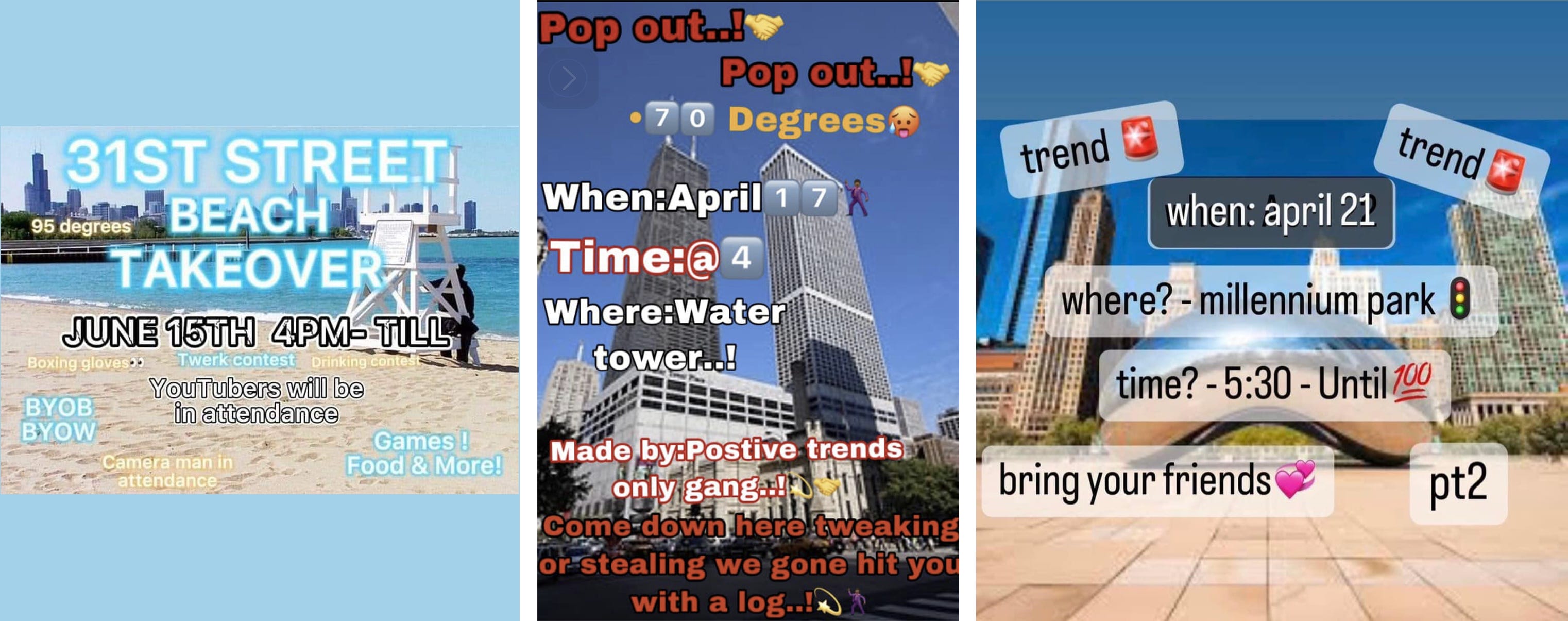
Social media postings encouraging so-called “teen takeovers” in Chicago. Source: wbez.org
For as long as I can remember since I’ve been in Chicago, the first warm day in early spring brings thousands of people outdoors. As soon as the temperature goes over 50° people remove their coats and soak in the (still low) sun. With the first 60°+ day, and the first 70°+ day, the same thing happens, but with increasingly more people.
Chicago’s not alone in this. I saw the same thing as a kid in Detroit, I’ve heard about it in other Midwestern cities, big and small. I remember how college students at Indiana University reacted to the first warm day in late March or early April. Suntanning kids all over campus.
Unfortunately, not everyone sees this as an opportunity to bask in the springtime sun. Others use it as an opportunity to unleash pent-up energy, causing chaos where possible. And with the rise of social media, allowing teens and young adults to quickly contact and organize others to meet up, I see this as the origin story for the rising phenomenon of teen takeovers.
Of course I’m aware on Chicago’s coverage on these, but they’re happening all over. Atlanta, Los Angeles, Milwaukee and New York City all have been in the news recently because of the phenomenon.
Last month, fellow Substacker Chris Arnade eloquently wrote about America’s problem with urban disorder. To be fair, I don’t think he was considering teen takeovers in his piece, which focused on the unhoused, drug-addicted and mentally ill people who wander American streets and dim our minds on the potential of American cities.
Arnade’s perspective is unique, because his Substack describes his walks in cities across the world. This quote here illustrates what he sees elsewhere that he does not see in his home country:
“You can learn more about the U.S. by traveling overseas and comparing, and five years of that has taught me we accept far too much public disorder.
We are the world’s richest country, and yet our buses, parking lots, and city streets are filthy, chaotic, and threatening. Antisocial and abnormal behavior, open addiction, and mentally tortured people are common in almost every community regardless of size.
I’ve written about this many times before, because it is so striking, and it has widespread consequences, beyond the obvious moral judgement that a society should simply not be this way.
It’s a primary reason why we shy away from dense walkable spaces and instead move towards suburban sprawl. People in the U.S. don’t respect, trust, or want to be around other random citizens, out of fear and disgust. Japanese/European style urbanism—density, fantastic public transport, mixed-use zoning, that so many American tourists admire—can’t happen here because there is a fine line between vibrant streets and squalid ones, and that line is public trust. The U.S. is on the wrong side of it. Simply put, nobody wants to be accosted by a stranger, no matter how infrequent, and until that risk is close to nil, people will continue edging towards isolated living.”
Why is this so for America?
For most of my adult life I believed that poor family structure or parenting, combined with America’s deep and enduring economic inequality, was the culprit. Struggling parents without the resources to offer their children a promising future open up possibilities for deficient education, addiction, criminal behavior to set in. That’s probably the prevailing attitude for many.
But I now see this as a flaw in the American system. We don’t have the institutional framework necessary to guide more young people into productive activities, teaching us all about our responsibility in a civil society.
Back in January I remember the New York Times posting an article about the nation’s declining homicide rate. The article’s lede – after a spike in homicides nationally during the Covid pandemic, the homicide rate resumed its decline and is now lower than at any time in the last 125 years. The chart below illustrates this fact well:
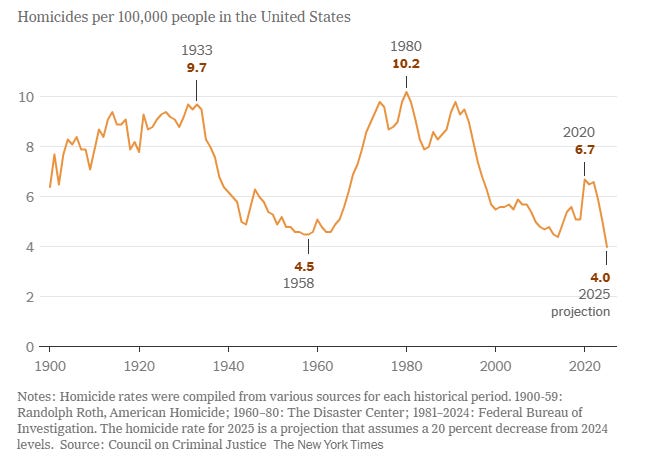
I’m sure that if someone asked the typical American citizen if the national homicide rate was higher or lower in 2025 compared to 1958 – a time when most would say 1958 was America’s economic and global cultural peak – they’d choose 1958. Certainly, Americans felt safer in 1958 than in 2025. I don’t hear anyone suggesting that now is the safest time in America in anyone’s lifetime.
But I look at that chart and draw a couple of other conclusions. The first is that America was incredibly violent during the first third of the 20th century, before undergoing a steep decline between 1933 and 1958. Then the last third of the century saw a rapid rise in the homicide rate, ultimately peaking in 1980, plateauing for a few years, and then beginning a slower decline in the ‘90s to its present level.
Here’s another way I read it. The economy did improve after the Depression and World War II. That the rising tide (mostly) lifted all boats. But I think what’s missed is that economic growth came with institutional growth as well. Churches played a much more prominent institutional role in society in mid-20th century America. So did charitable organizations, service organizations, even social organizations. The nation achieved its homicide decline with the economy and society working in concert.
Then, somewhere in the late 1950’s/early 1960’s, economy and society separated from each other. As societal problems grew, those with the economic means began “edging towards isolated living,” as Arnade suggests.
Time to pull this tangent back in.
Teen takeovers are a symptom of the loss of institutions in America. This is something that can’t be addressed at the federal, state or local levels of government, nor at the family level. For too long, we’ve relied on our educational system to play this civic/institutional role on its own. We can’t expect that anymore.
In the past we relied on institutions more than we’d like to believe. Maybe deconstructing them wasn’t such a good idea.
In 6 linked articles by 6 different news organizations, not ONE talked to a single teenager about the situation. They all have a paternalistic and dehumanizing tone. Teens should be allowed to have large unchaperoned park parties, and they are fully mentally capable of taking necessary actions to make them safe.
We cannot understand what happens during these events that make them wild without listening to teens who were there.
We cannot expect teens who were there to talk to us if we continue to patronize and police them like this.
We cannot develop a city where it is good to be a teenager if we do not hear them out.
This all has been just a frivolous exercise in guess work while the police response to these situations is to arrest children.
When you say “institutions”, do you mean third places?
Because that’s the primary thing that the suburbs killed off for teenagers. Malls were a kind of substitute for quite a while, but the internet killed them off at the same time as it made informal, impromptu organizing more viable for teens.
Seems like this is a simpler symptomatic explanation than “institutions”. The teens literally have nowhere to go to call their own.